CometBFT QA Results v0.34.x
v0.34.x - From Tendermint Core to CometBFT
This section reports on the QA process we followed before releasing the firstv0.34.x version
from our CometBFT repository.
The changes with respect to the last version of v0.34.x
(namely v0.34.26, released from the Informal Systems’ Tendermint Core fork)
are minimal, and focus on rebranding our fork of Tendermint Core to CometBFT in places
where there is no substantial risk of breaking compatibility
with earlier Tendermint Core versions of v0.34.x.
Indeed, CometBFT versions of v0.34.x (v0.34.27 and subsequent) should fulfill
the following compatibility-related requirements:
- Operators can easily upgrade a
v0.34.xversion of Tendermint Core to CometBFT. - Upgrades from Tendermint Core to CometBFT can be uncoordinated for versions of the
v0.34.xbranch. - Nodes running CometBFT must be interoperable with those running Tendermint Core in the same chain,
as long as all are running a
v0.34.xversion.
v0.34.x
versions, combined with the CometBFT release candidate under test.
Therefore, our testing focuses on the last Tendermint Core version (v0.34.26) and the CometBFT release
candidate under test.
We run the 200 node test, but not the rotating node test. The effort of running the latter
is not justified given the amount and nature of the changes we are testing with respect to the
full QA cycle run previously on v0.34.x.
Since the changes to the system’s logic are minimal, we are interested in these performance requirements:
- The CometBFT release candidate under test performs similarly to Tendermint Core (i.e., the baseline)
- when used at scale (i.e., in a large network of CometBFT nodes)
- when used at scale in a mixed network (i.e., some nodes are running CometBFT and others are running an older Tendermint Core version)
- A homogeneous 200-node testnet, where all nodes are running the CometBFT release candidate under test.
- A mixed network where 1/2 (99 out of 200) of the nodes are running the CometBFT release candidate under test,
and the rest (101 out of 200) are running Tendermint Core
v0.34.26. - A mixed network where 1/3 (66 out of 200) of the nodes are running the CometBFT release candidate under test,
and the rest (134 out of 200) are running Tendermint Core
v0.34.26. - A mixed network where 2/3 (133 out of 200) of the nodes are running the CometBFT release candidate under test,
and the rest (67 out of 200) are running Tendermint Core
v0.34.26.
Configuration and Results
In the following sections we provide the results of the 200 node test. Each section reports the baseline results (for reference), the homogeneous network scenario (all CometBFT nodes), and the mixed networks with 1/2, 1/3, and 2/3 of Tendermint Core nodes.Saturation Point
As the CometBFT release candidate under test has minimal changes with respect to Tendermint Corev0.34.26, other than the rebranding changes,
we can confidently reuse the results from the v0.34.x baseline test regarding
the saturation point.
Therefore, we will simply use a load of (r=200,c=2)
(see the explanation here) on all experiments.
We also include the baseline results for quick reference and comparison.
Experiments
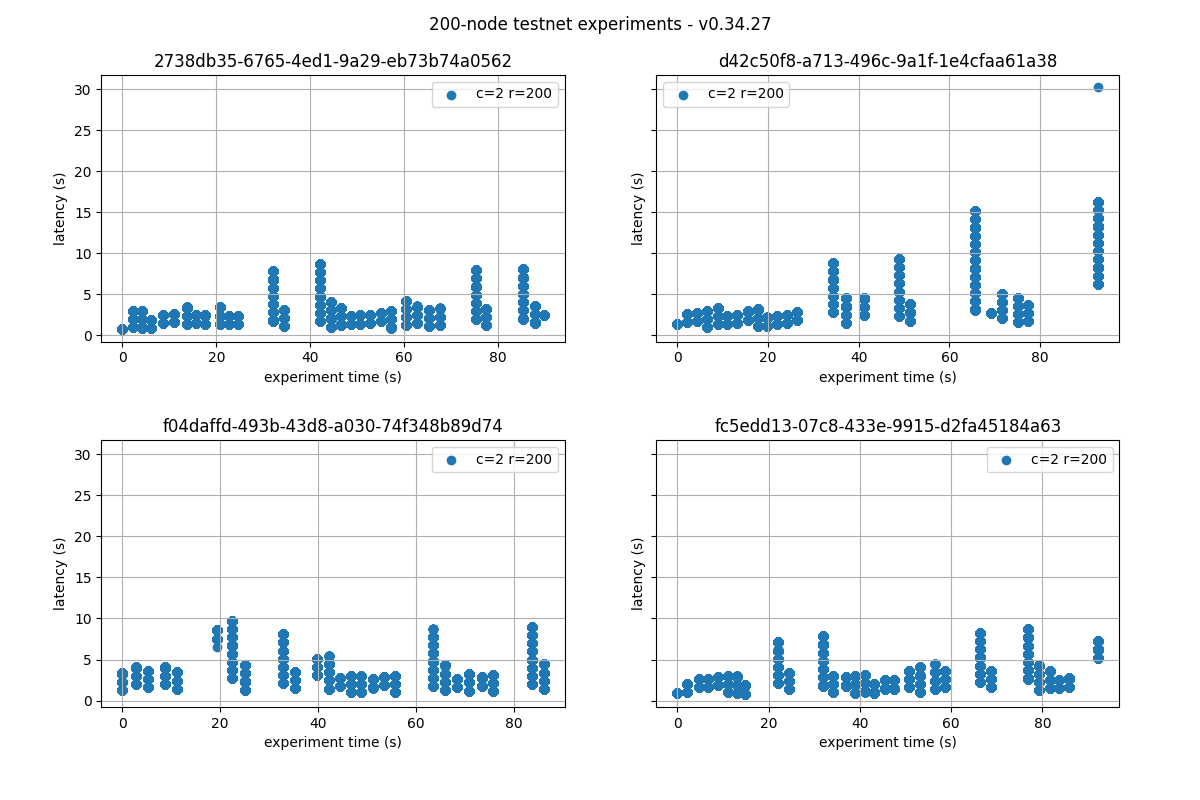
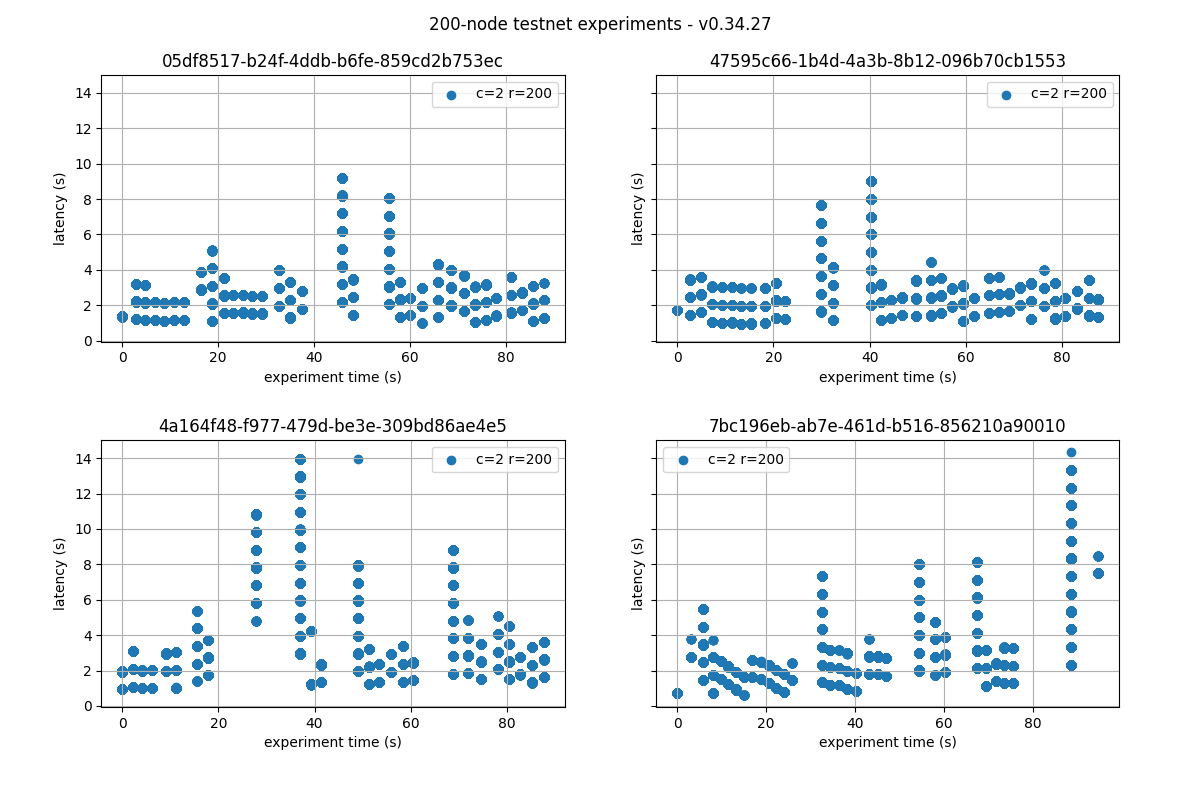
On each of the three networks, the test consists of 4 experiments, with the goal of ensuring the data obtained is consistent across experiments. On each of the networks, we pick only one representative run to present and discuss the results.Examining Latencies
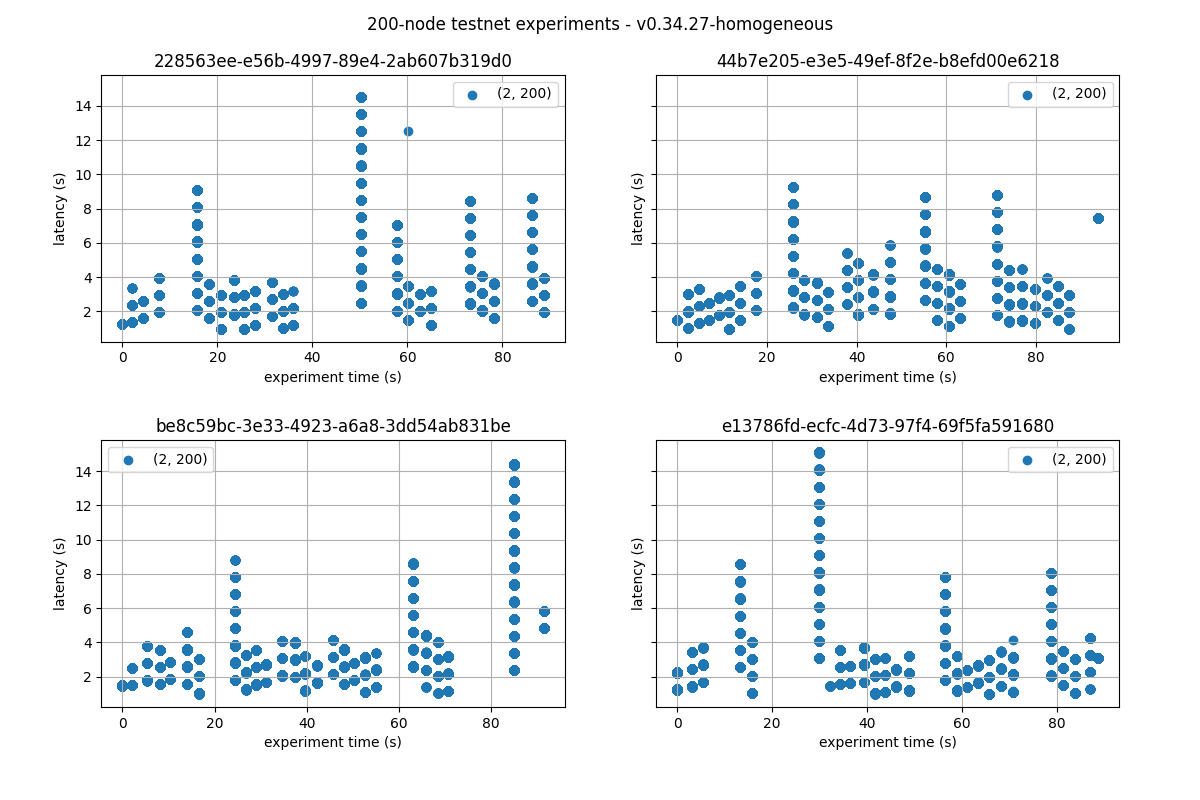
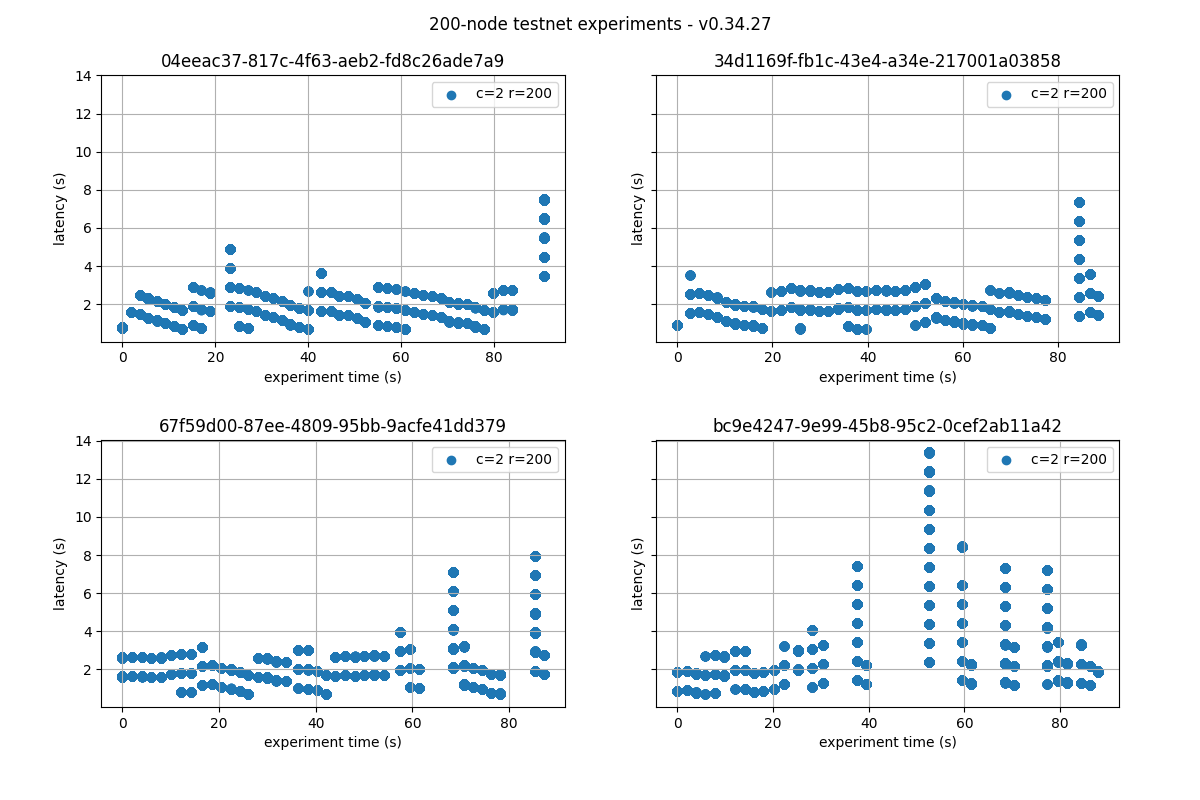
For each network, the figures plot the four experiments carried out with the network. We can see that the latencies follow comparable patterns across all experiments. Unique identifiers (UUIDs) for each execution are presented on top of each graph. We refer to these UUIDs to indicate the representative runs.CometBFT Homogeneous Network
1/2 Tendermint Core - 1/2 CometBFT
1/3 Tendermint Core - 2/3 CometBFT
2/3 Tendermint Core - 1/3 CometBFT
Prometheus Metrics
This section reports on the key Prometheus metrics extracted from the following experiments:- Baseline results:
v0.34.x, obtained in October 2022 and reported here. - CometBFT homogeneous network: experiment with UUID starting with
be8c. - Mixed network, 1/2 Tendermint Core
v0.34.26and 1/2 running CometBFT: experiment with UUID starting with04ee. - Mixed network, 1/3 Tendermint Core
v0.34.26and 2/3 running CometBFT: experiment with UUID starting withfc5e. - Mixed network, 2/3 Tendermint Core
v0.34.26and 1/3 running CometBFT: experiment with UUID starting with4759.
Mempool Size
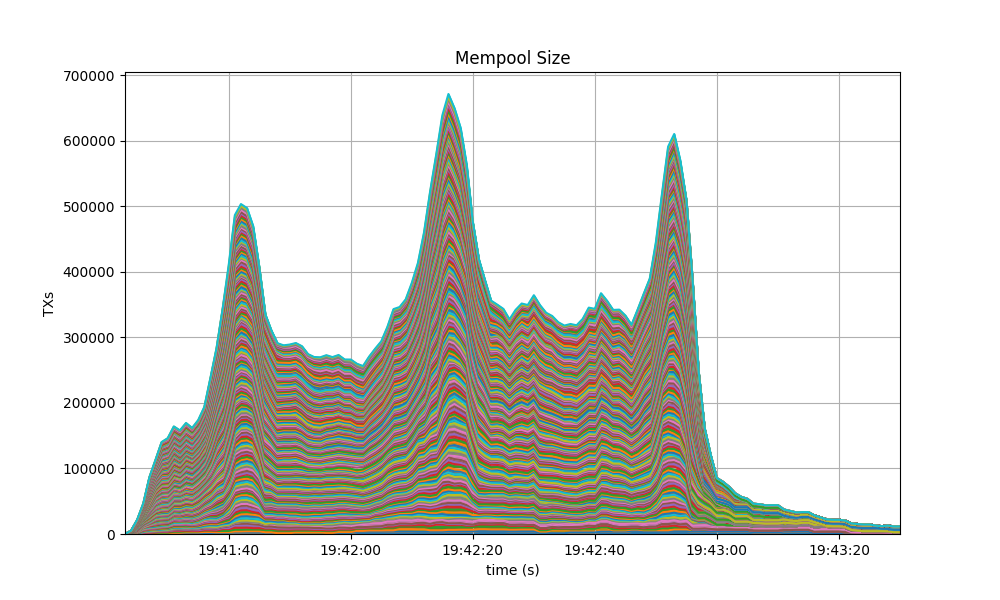
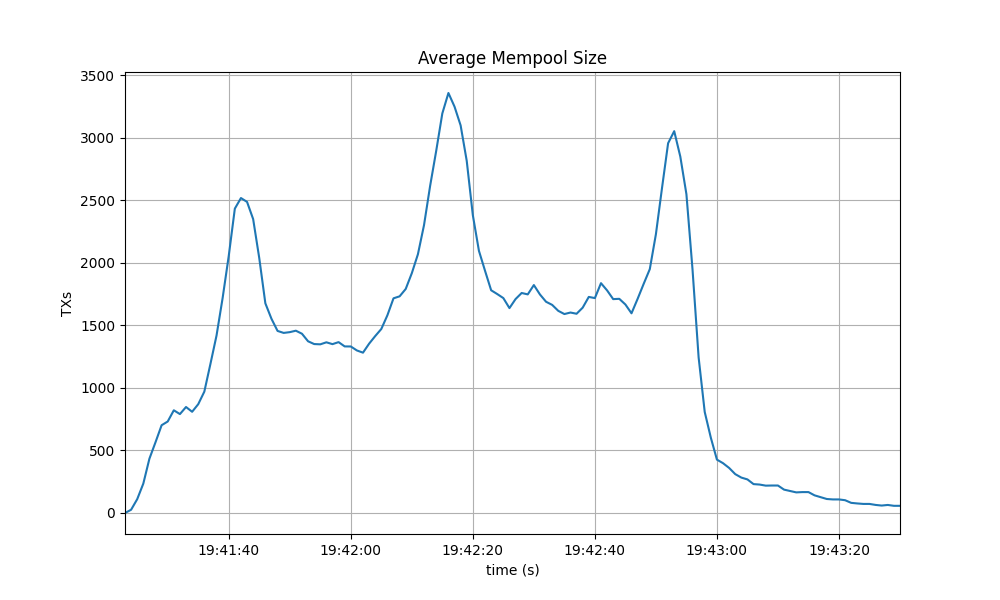
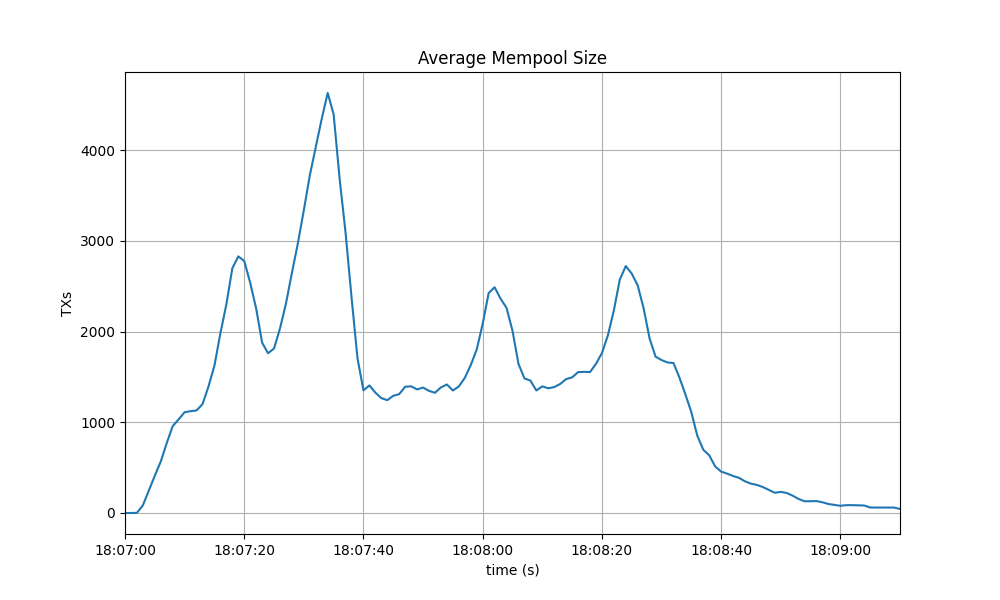
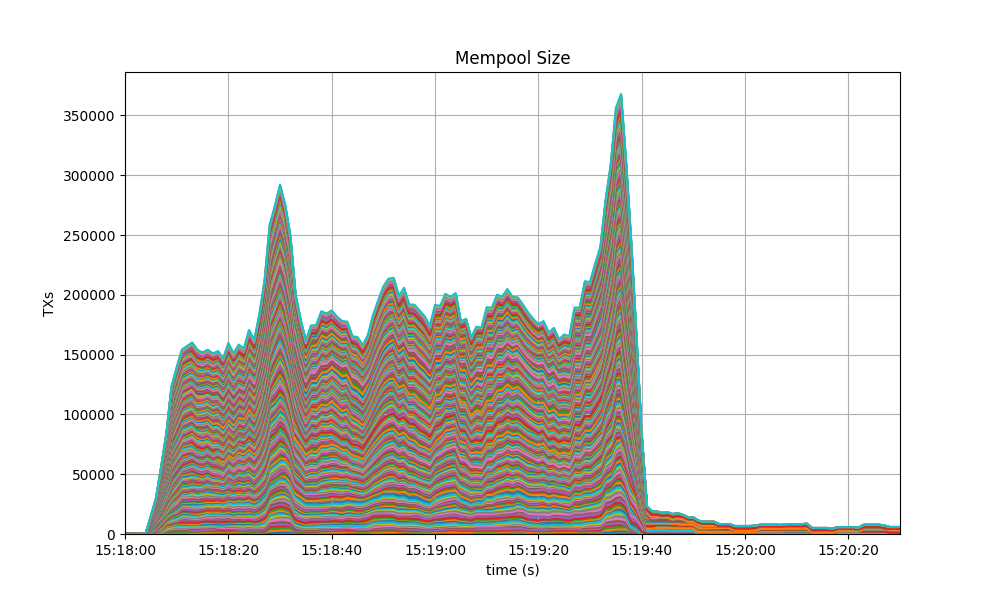
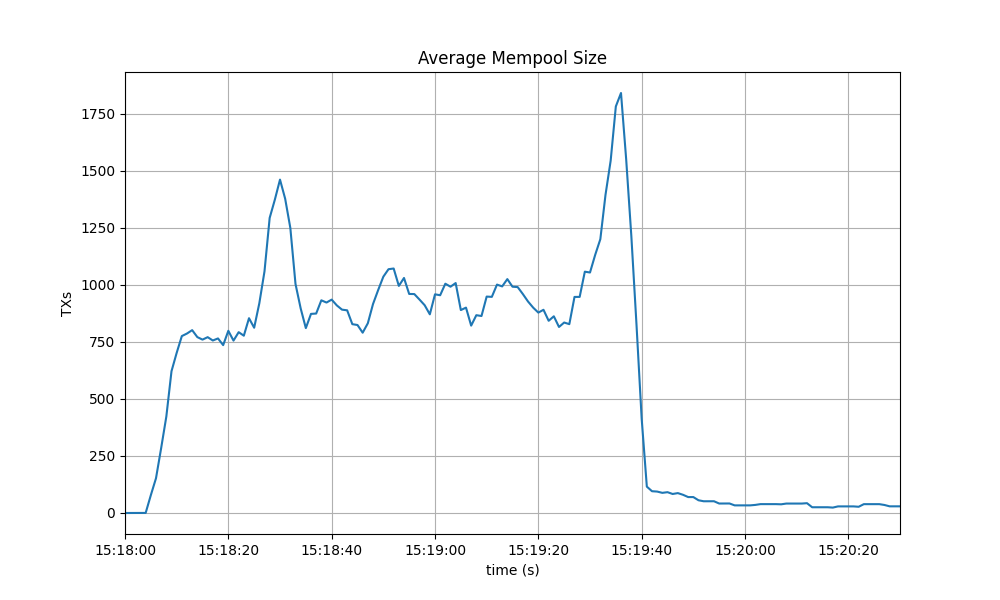
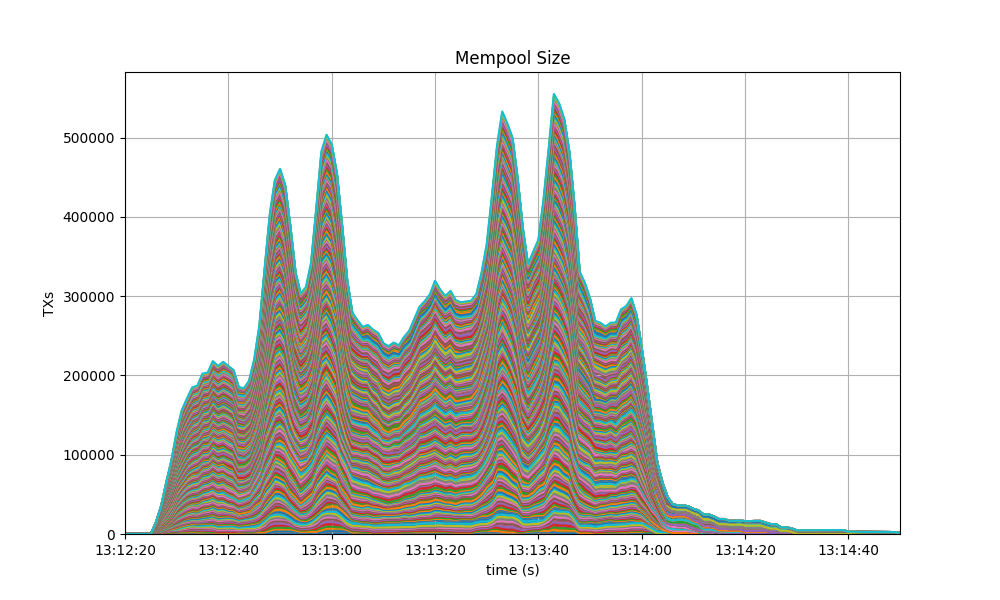
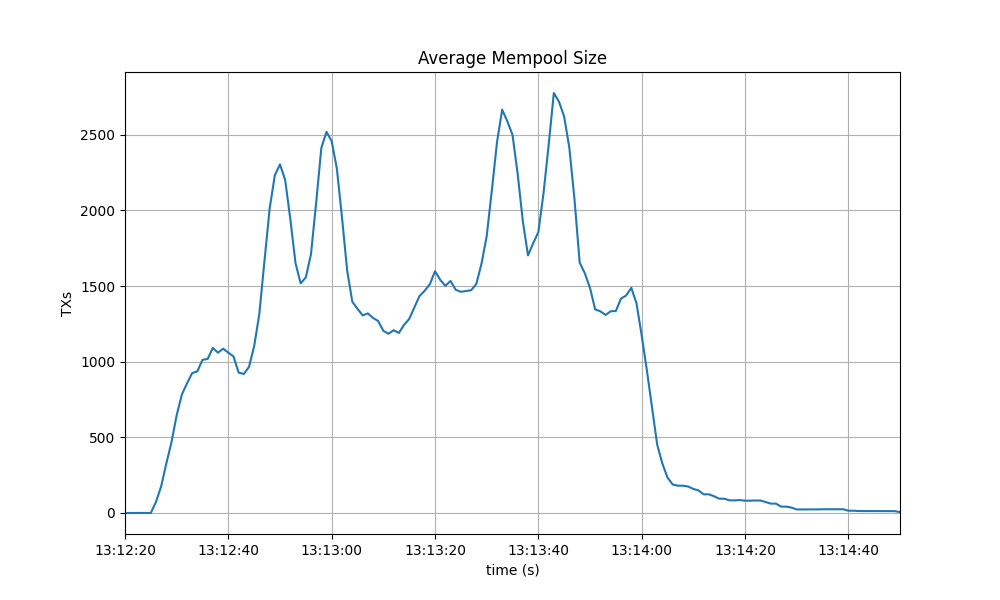
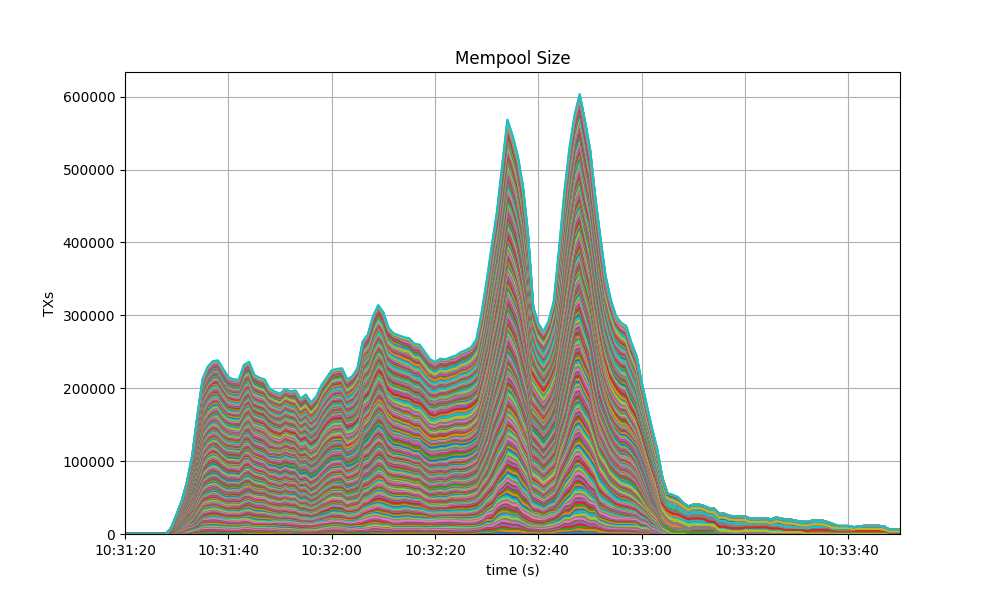
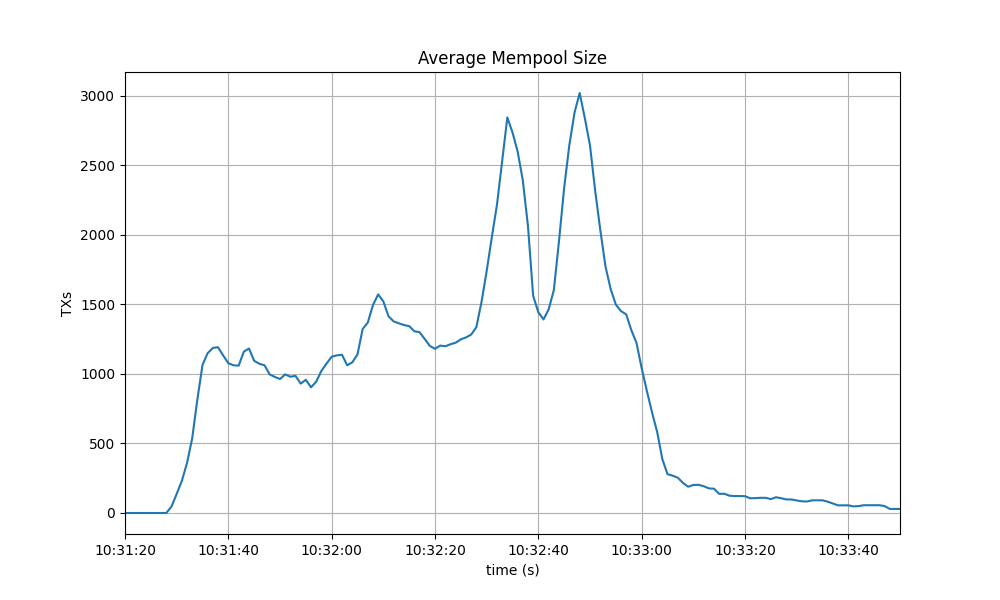
For each reported experiment, we show two graphs. The first shows the evolution over time of the cumulative number of transactions inside all full nodes’ mempools at a given time. The second one shows the evolution of the average over all full nodes.Baseline
CometBFT Homogeneous Network
The results for the homogeneous network and the baseline are similar in terms of outstanding transactions.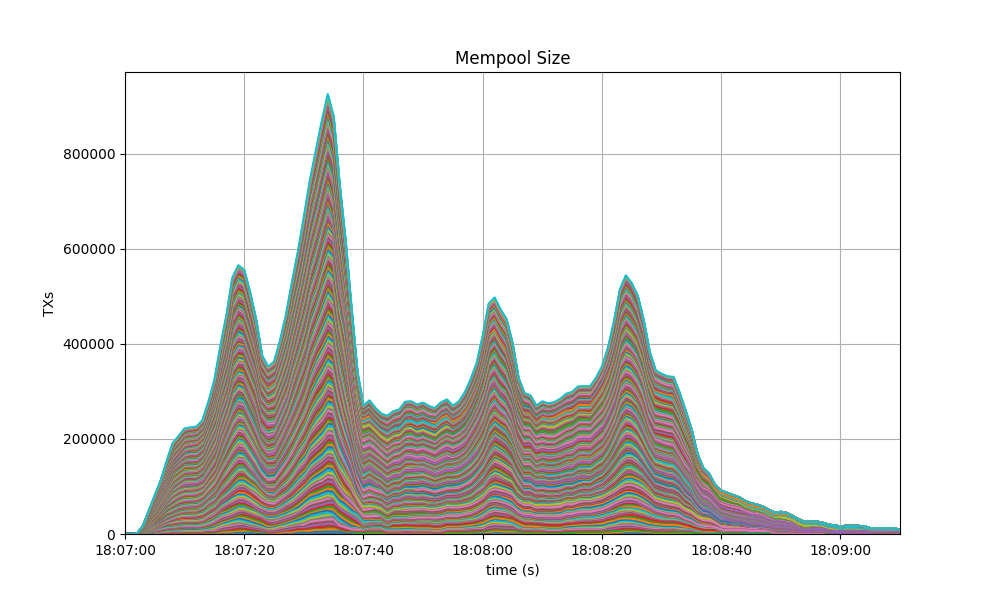
1/2 Tendermint Core - 1/2 CometBFT
1/3 Tendermint Core - 2/3 CometBFT
2/3 Tendermint Core - 1/3 CometBFT
Consensus Rounds per Height
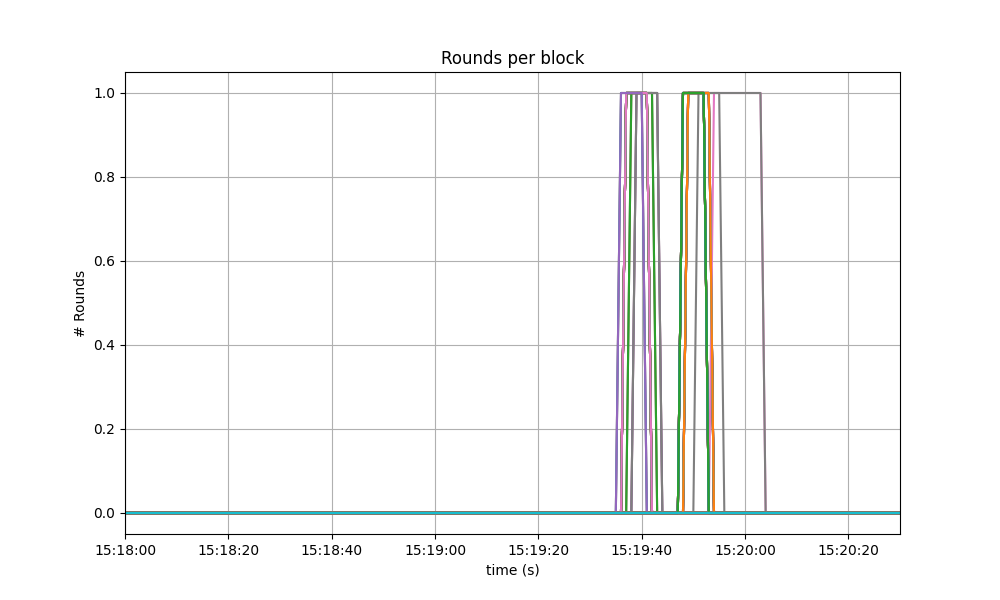
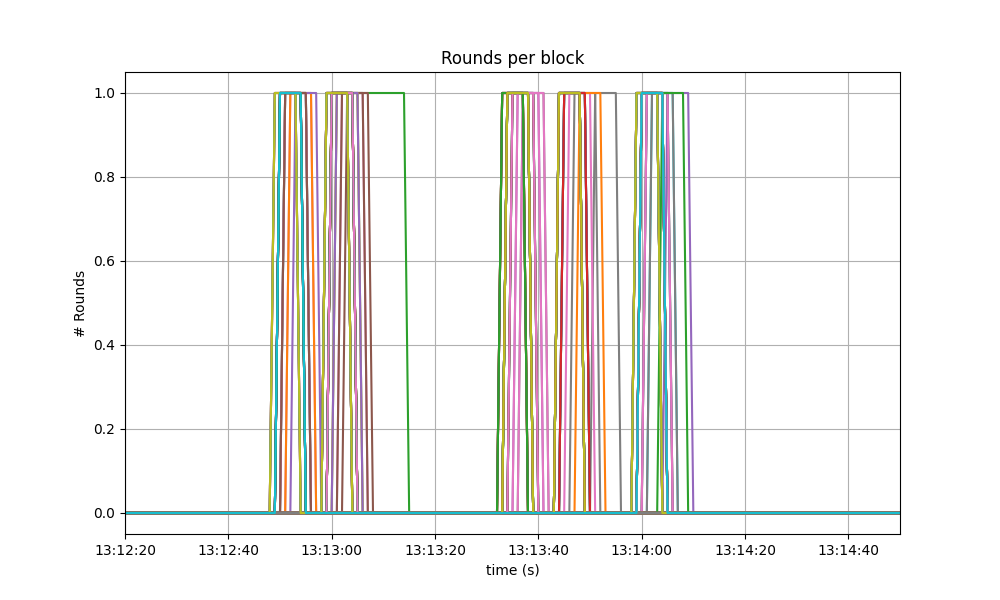
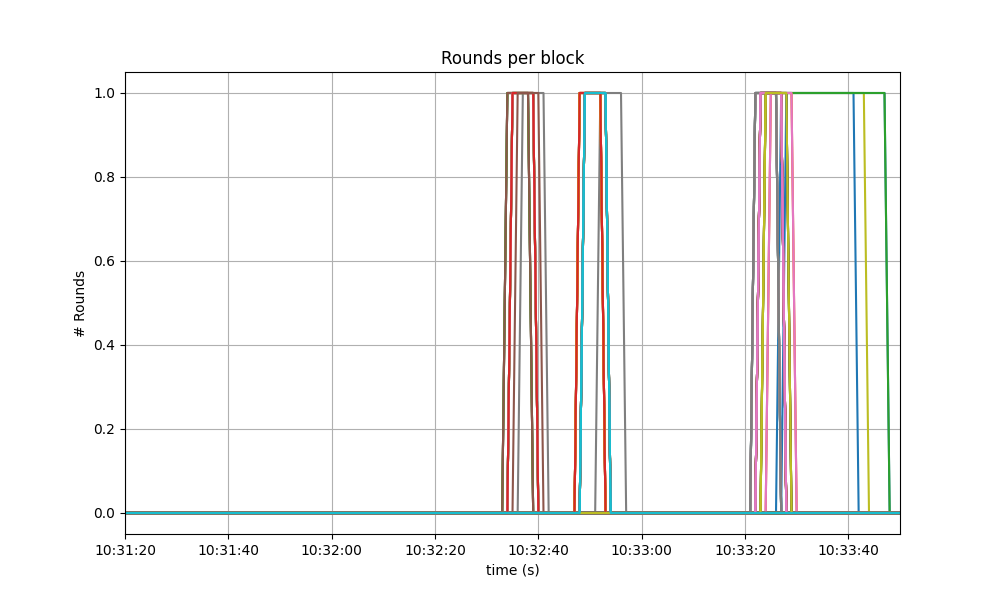
The following graphs show the rounds needed to complete each height and agree on a block. A value of0 shows that only one round was required (with ID 0), and a value of 1 shows that two rounds were required.
Baseline
We can see that round 1 is reached with a certain frequency.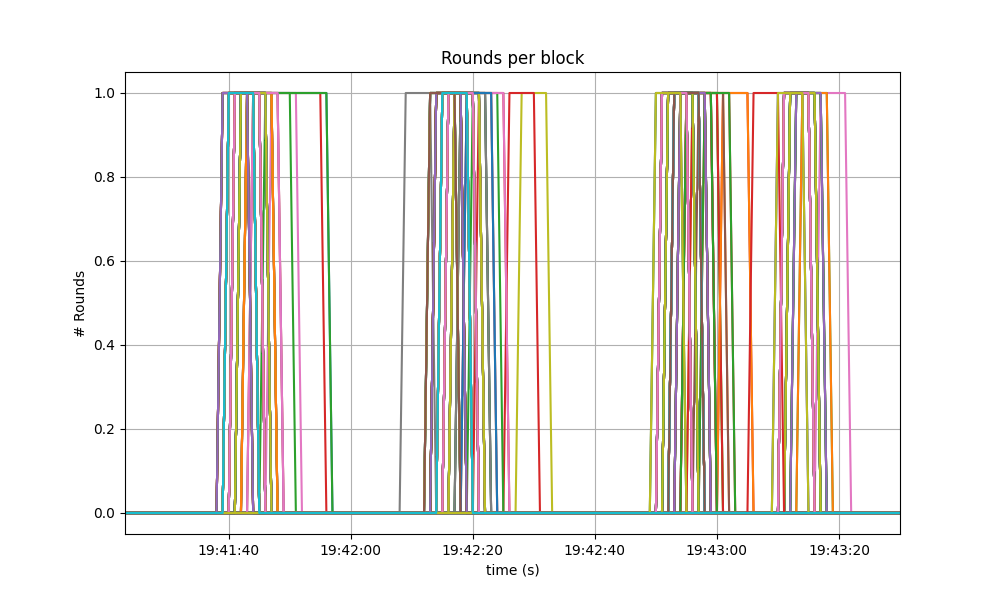
CometBFT Homogeneous Network
Most heights finished in round 0. Some nodes needed to advance to round 1 at various moments, and a few nodes even needed to advance to round 2 at one point. This coincides with the time at which we observed the biggest peak in mempool size on the corresponding plot shown above.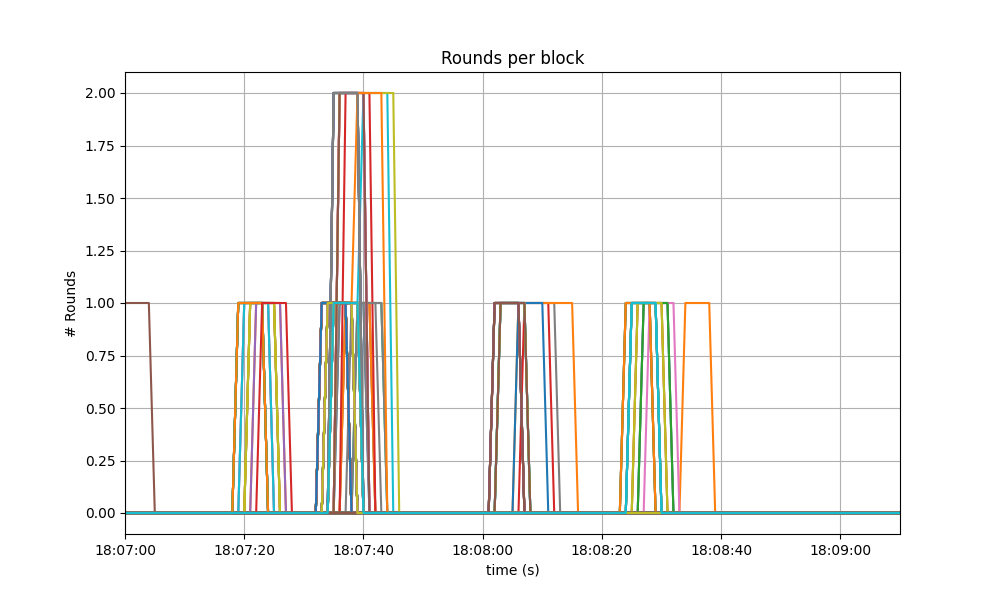
1/2 Tendermint Core - 1/2 CometBFT
1/3 Tendermint Core - 2/3 CometBFT
2/3 Tendermint Core - 1/3 CometBFT
Peers
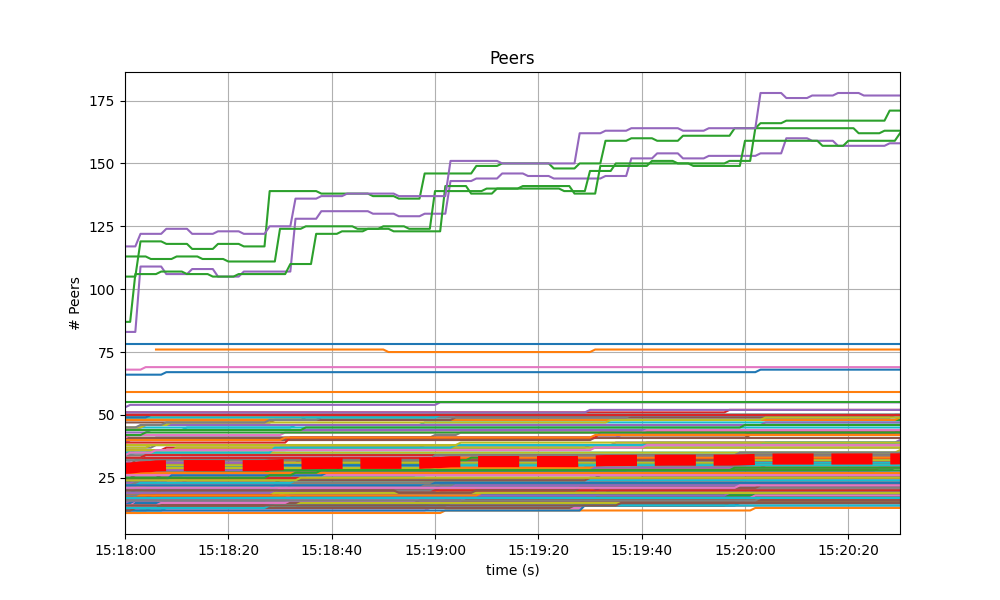
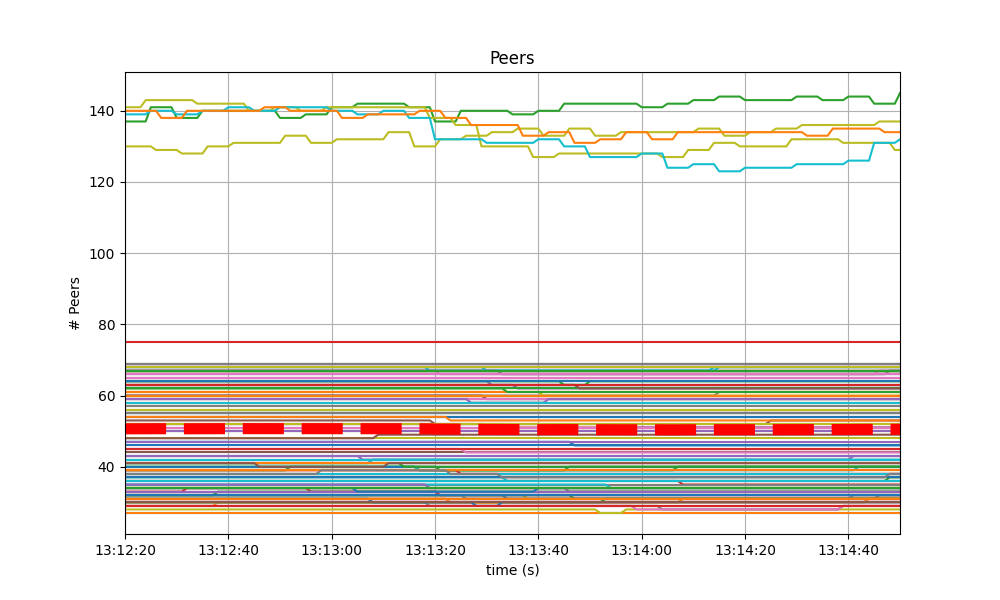
The following plots show how many peers a node had throughout the experiment. The thick red dashed line represents the moving average over a sliding window of 20 seconds.Baseline
The following graph shows that the number of peers was stable throughout the experiment. Seed nodes typically have a higher number of peers. The fact that non-seed nodes reach more than 50 peers is due to #9548.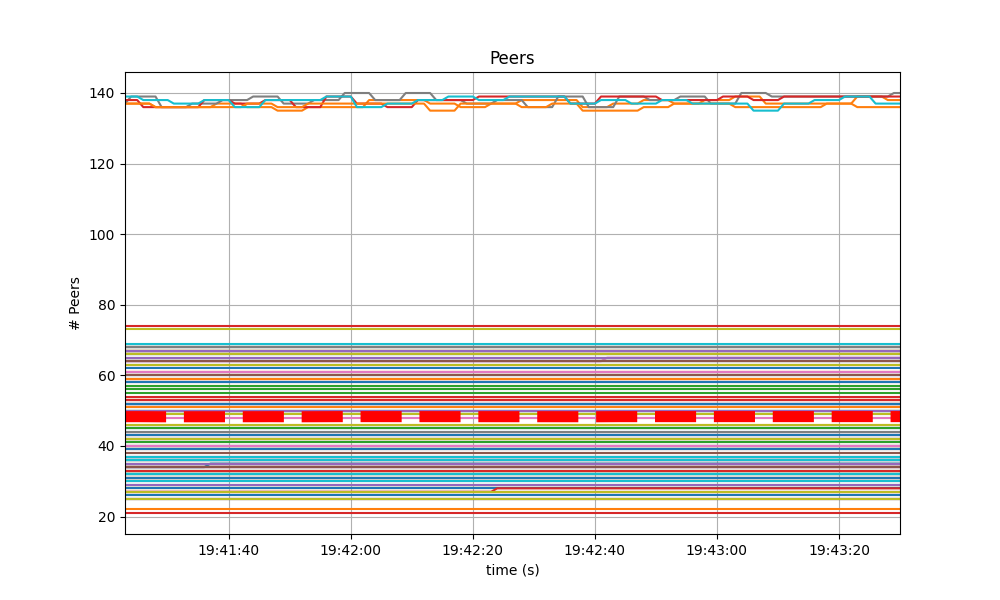
CometBFT Homogeneous Network
The results for the homogeneous network are very similar to the baseline. The only difference is that the seed nodes seem to lose peers in the middle of the experiment. However, this cannot be attributed to the differences in the code, which are mainly rebranding.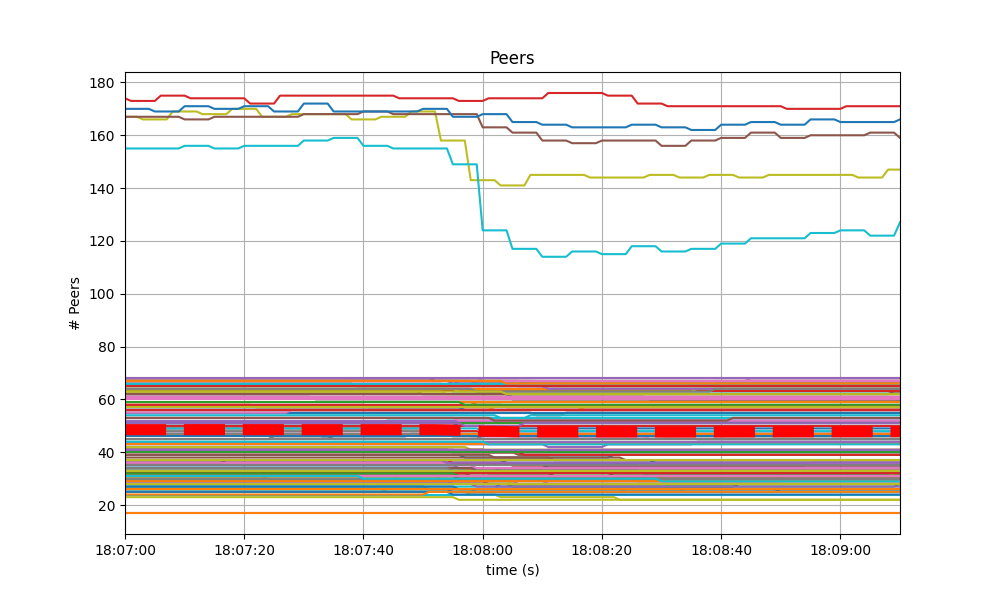
1/2 Tendermint Core - 1/2 CometBFT
1/3 Tendermint Core - 2/3 CometBFT
2/3 Tendermint Core - 1/3 CometBFT
As in the homogeneous case, there is some variation in the number of peers for some nodes. These, however, do not affect the average.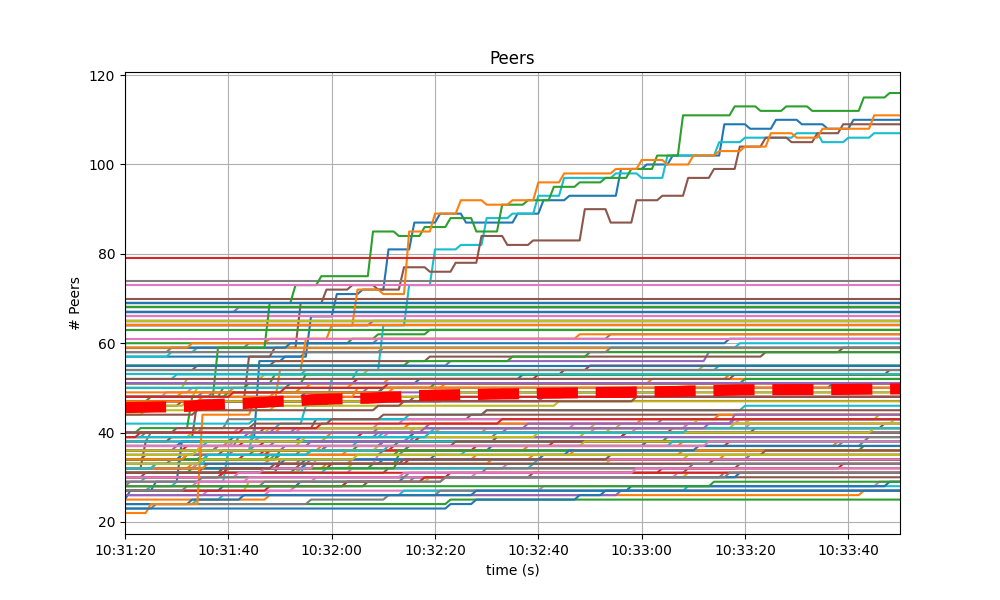
Blocks Produced per Minute, Transactions Processed per Minute
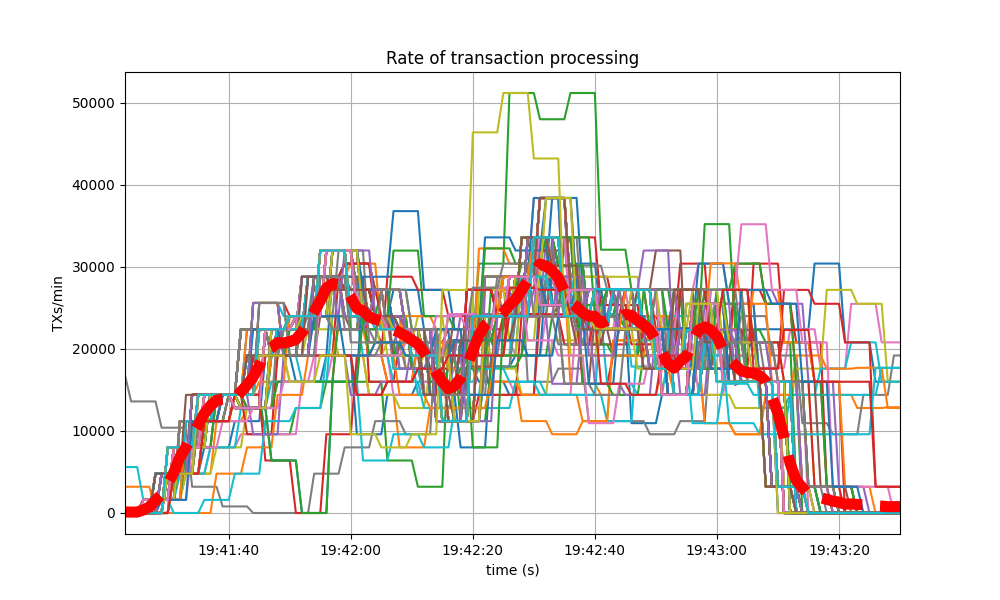
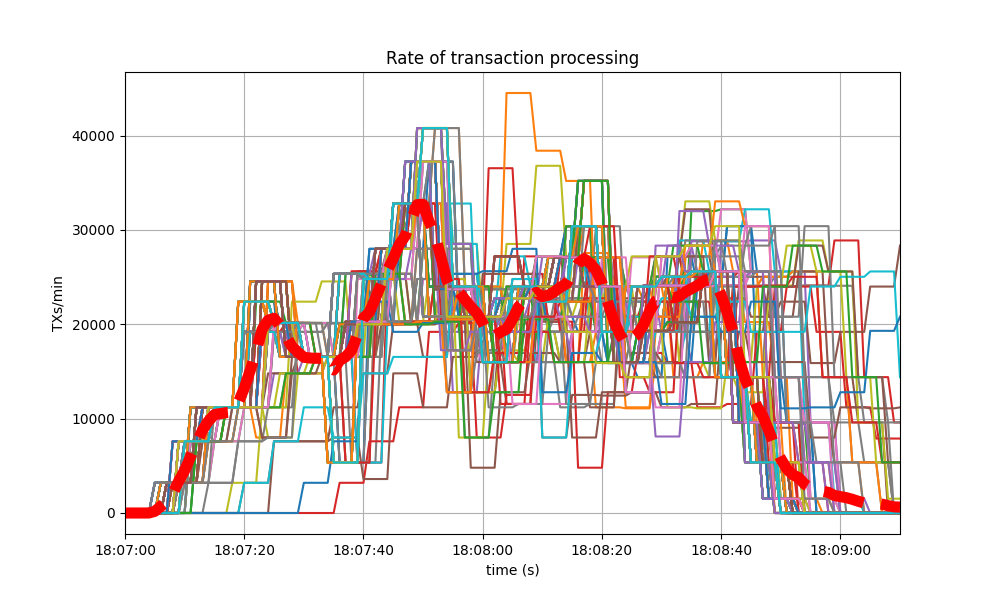
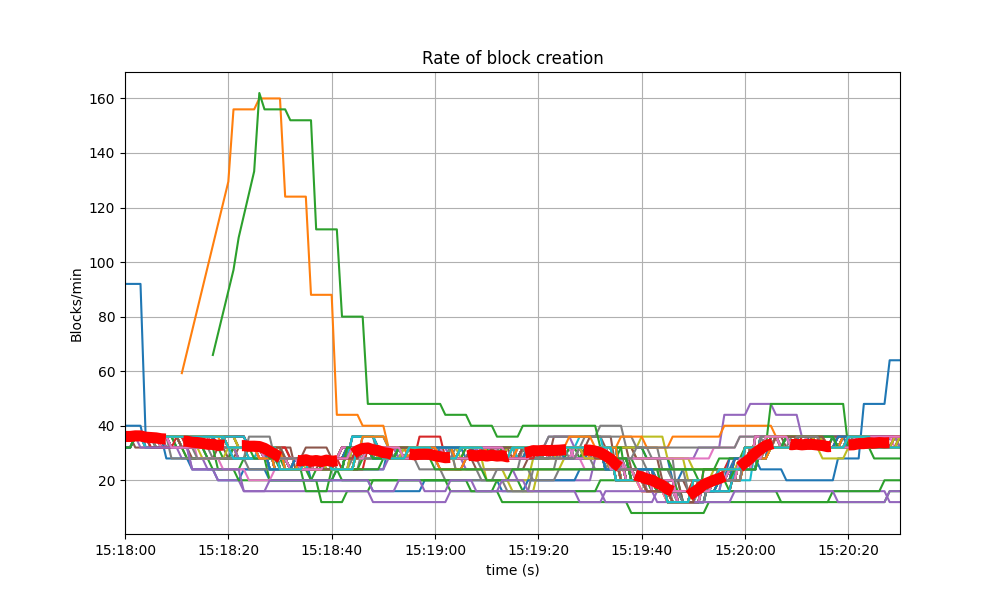
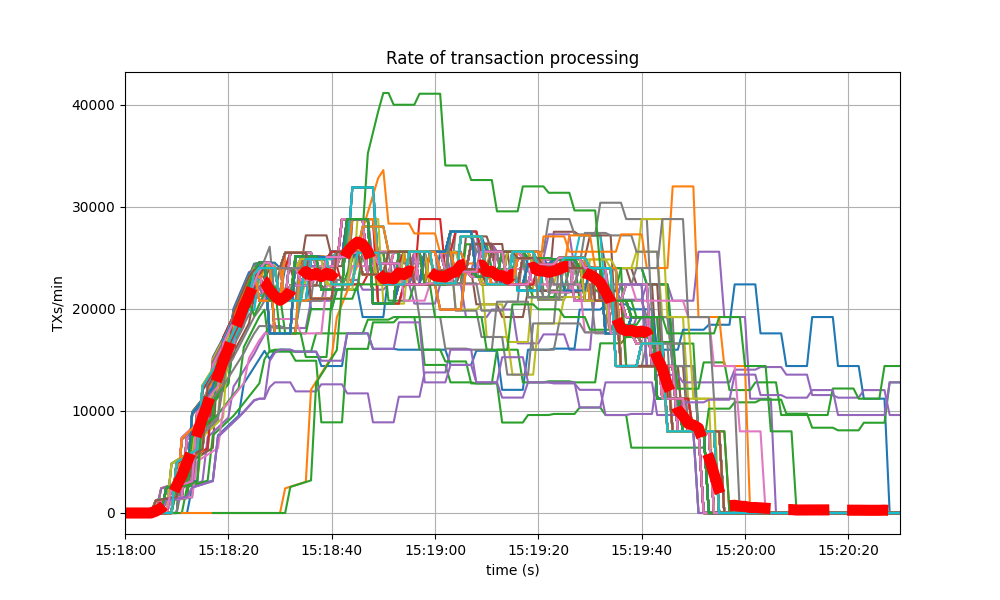
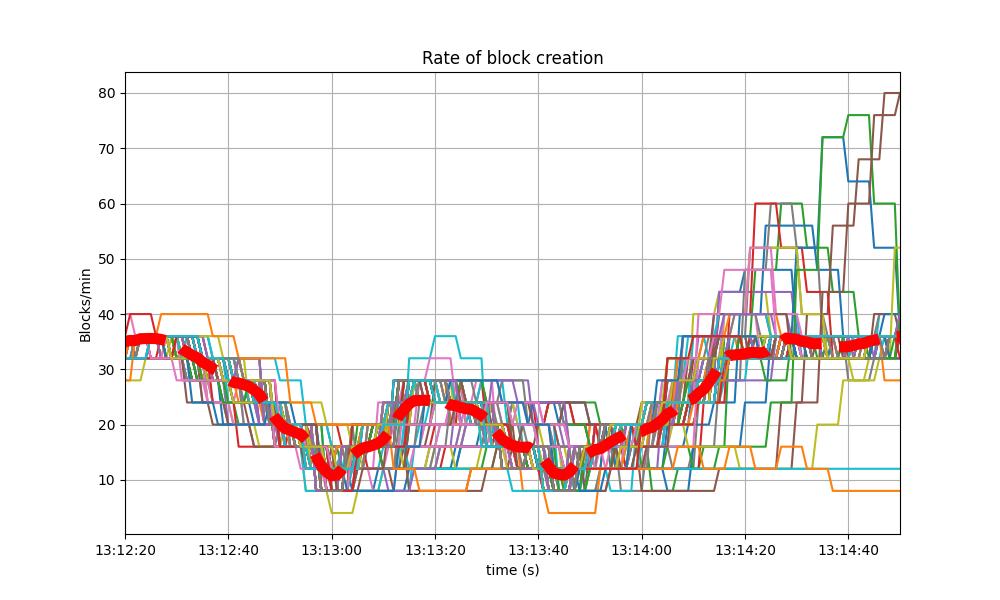
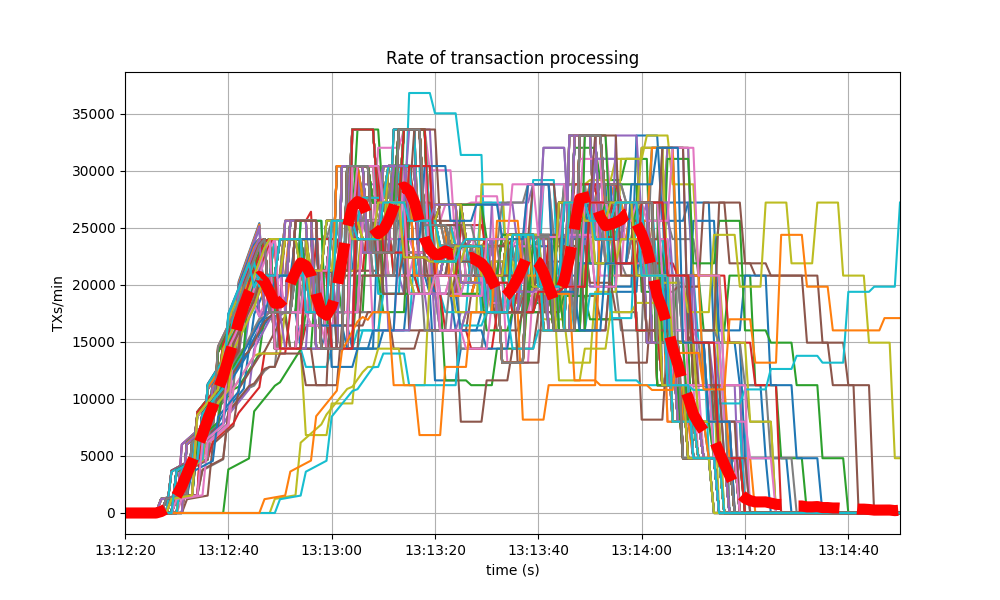
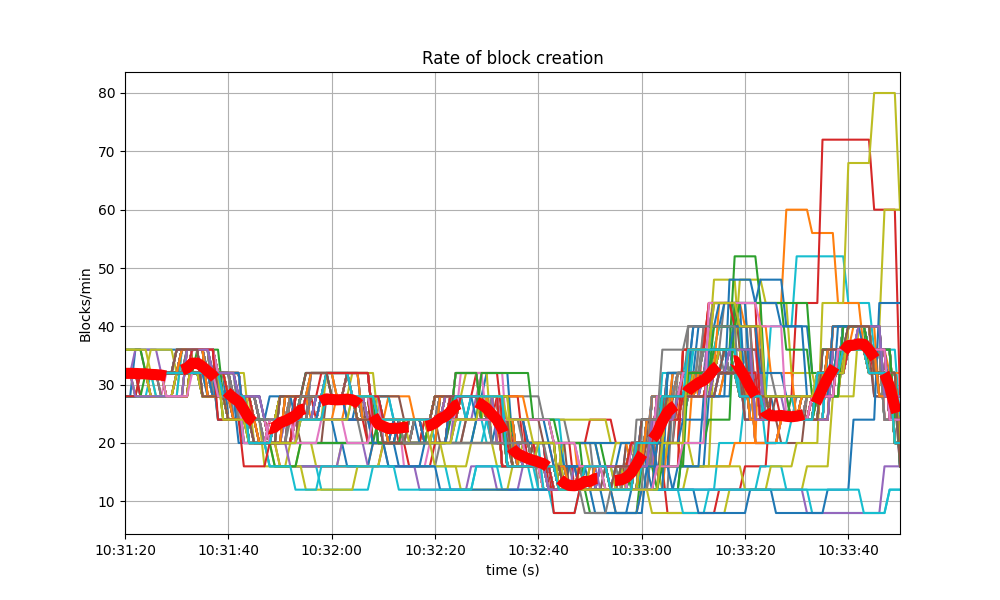
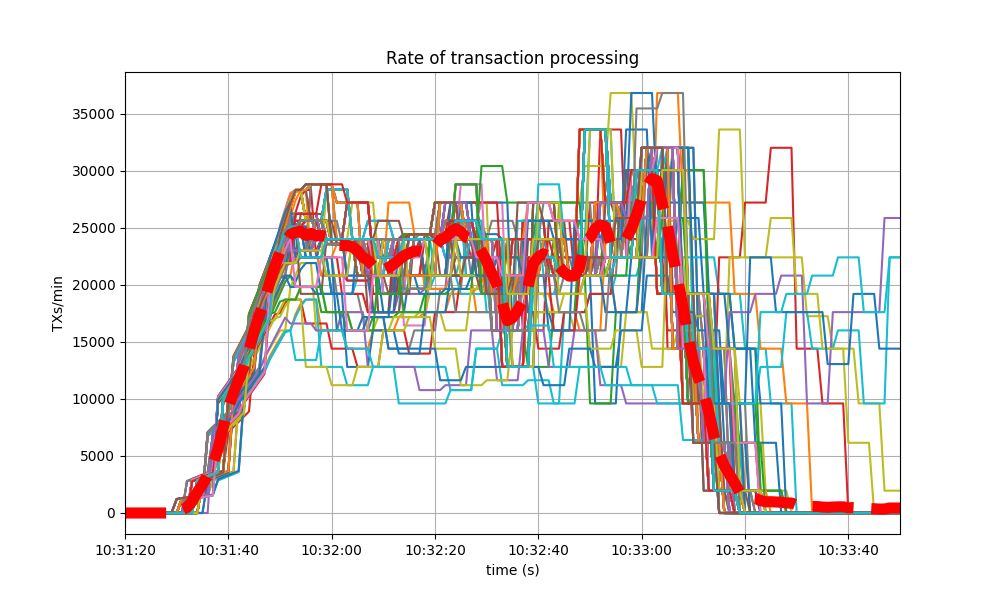
The following plots show the rate of block production and the rate of transactions delivered throughout the experiments. In both graphs, rates are calculated over a sliding window of 20 seconds. The thick red dashed line shows the rates’ moving averages.Baseline
The average number of blocks per minute oscillates between 10 and 40.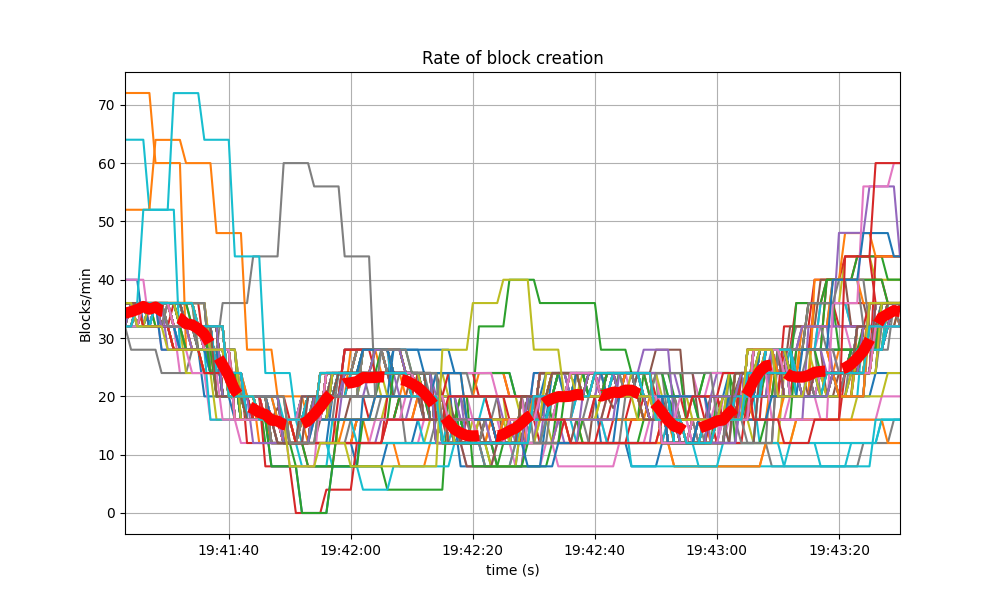
CometBFT Homogeneous Network
The plot showing the block production rate shows that the rate oscillates around 20 blocks per minute, mostly within the same range as the baseline.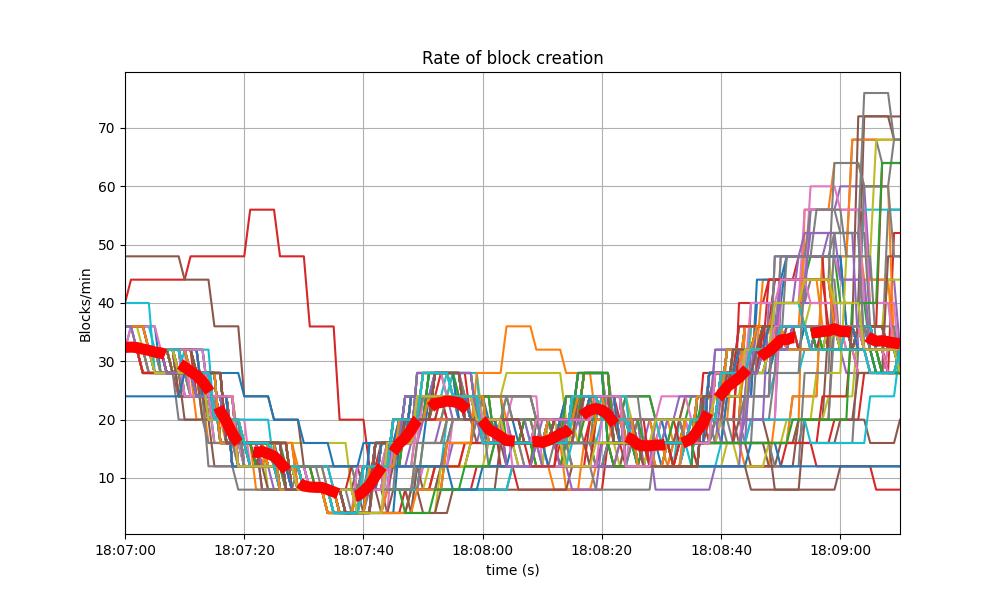
1/2 Tendermint Core - 1/2 CometBFT
1/3 Tendermint Core - 2/3 CometBFT
2/3 Tendermint Core - 1/3 CometBFT
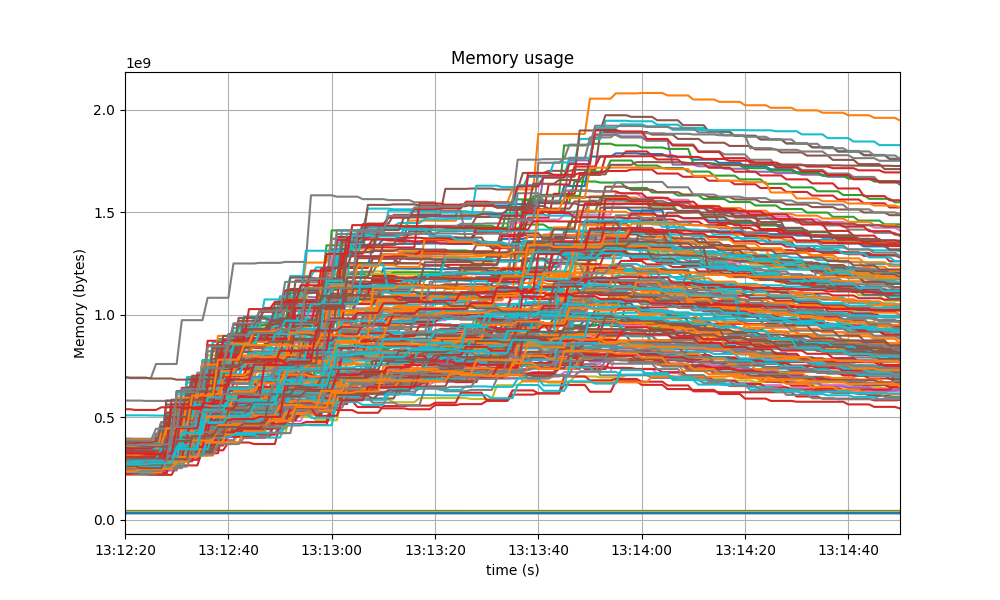
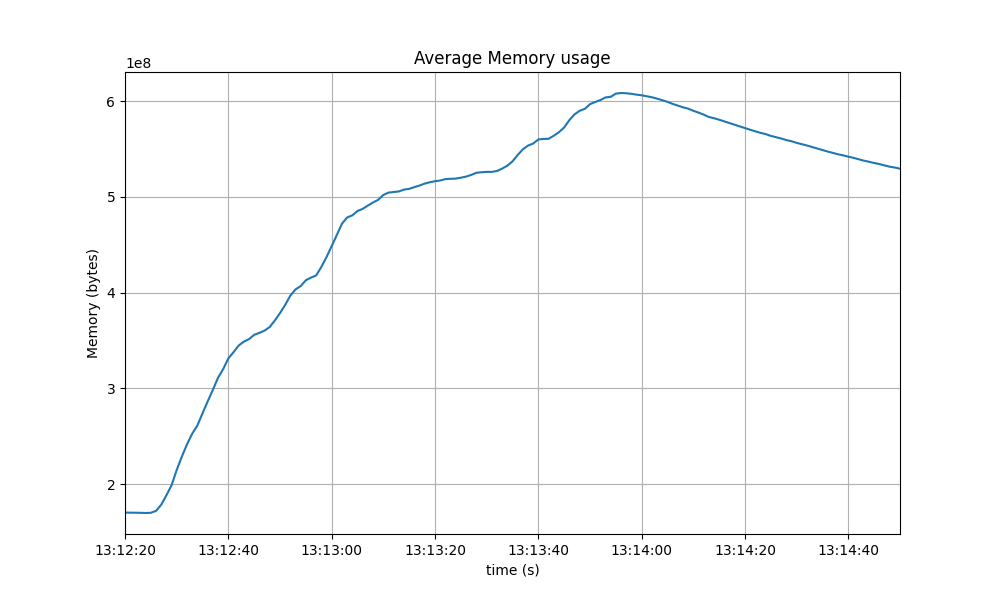
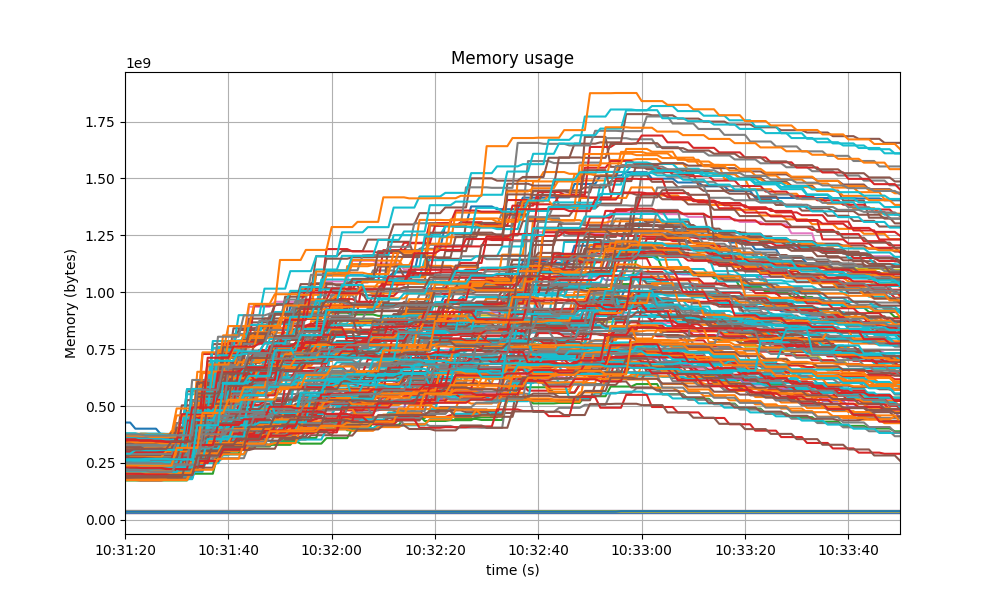
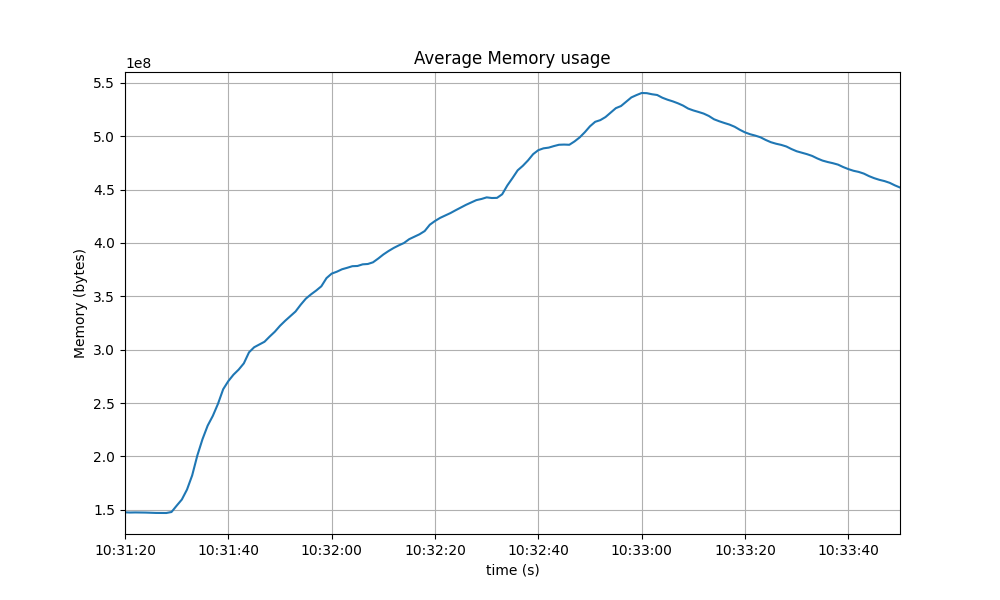
Memory Resident Set Size
The following graphs show the Resident Set Size (RSS) of all monitored processes and the average value.Baseline
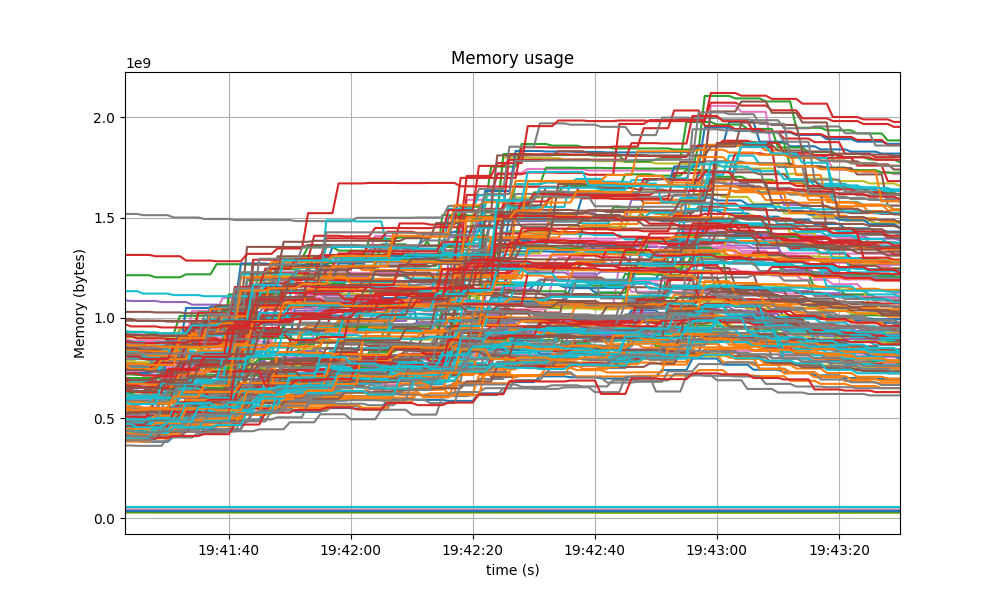
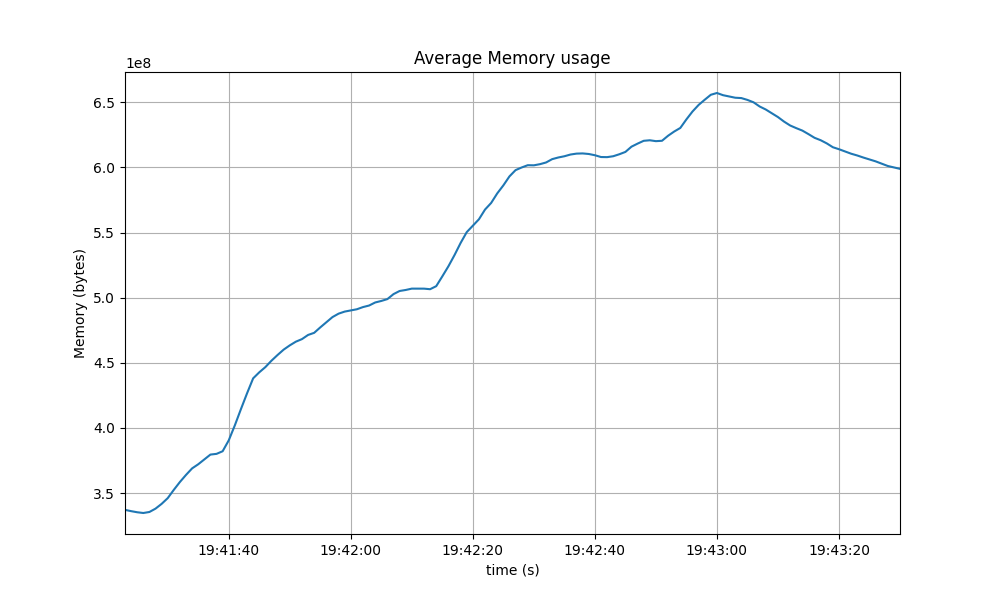
CometBFT Homogeneous Network
This is the plot for the homogeneous network, which is slightly more stable than the baseline over the time of the experiment.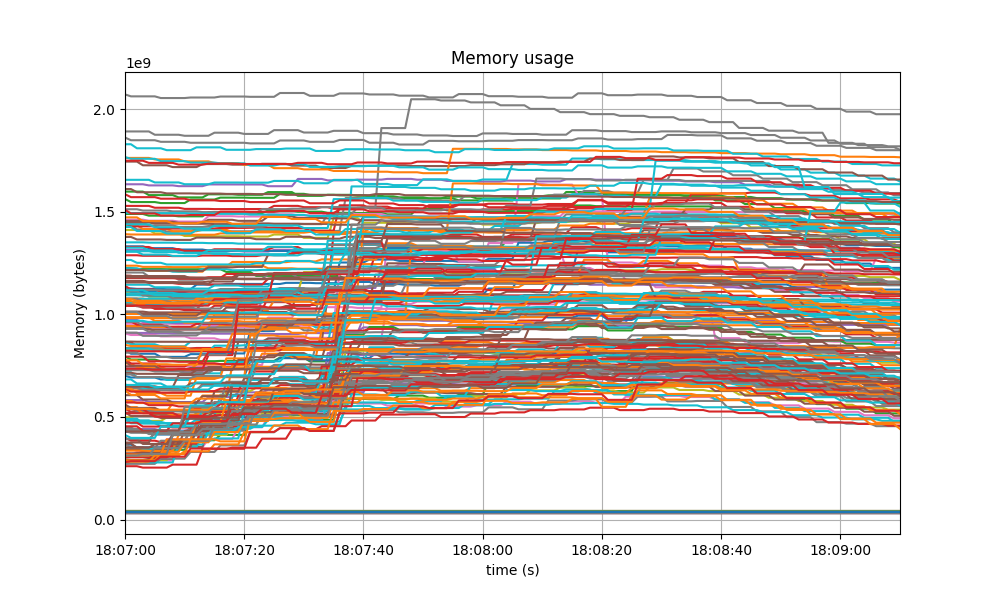
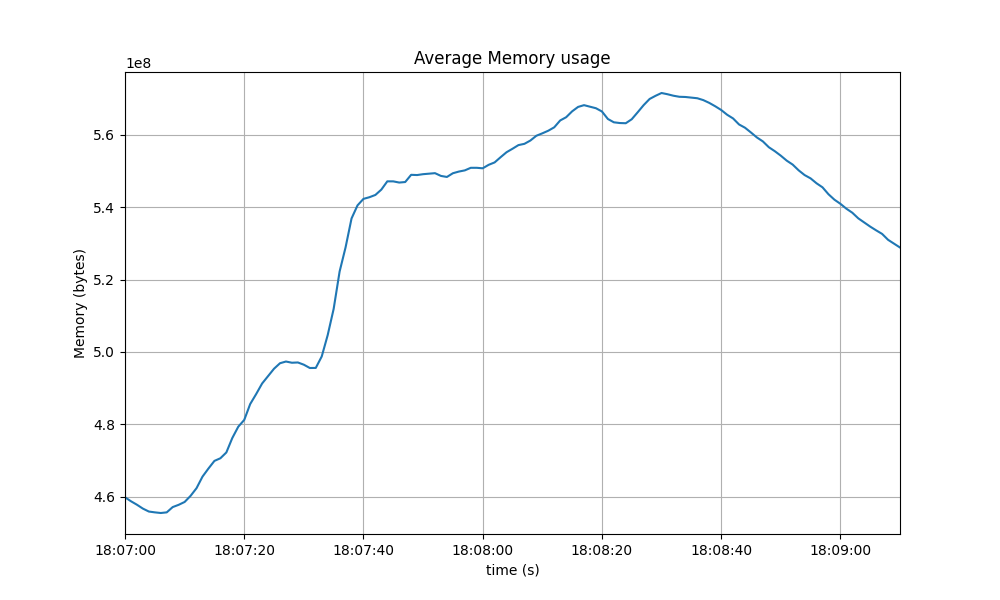
1/2 Tendermint Core - 1/2 CometBFT
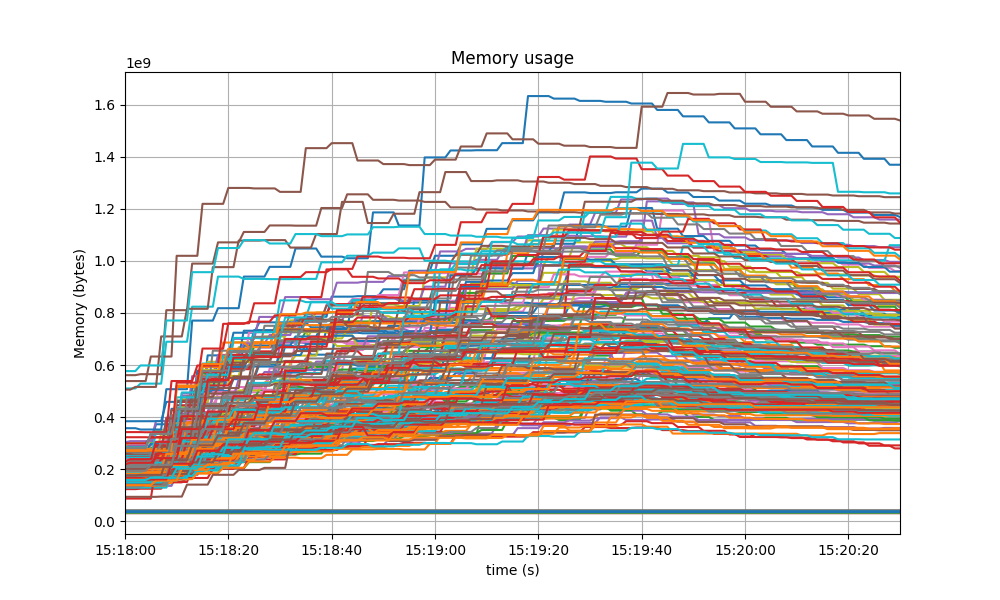
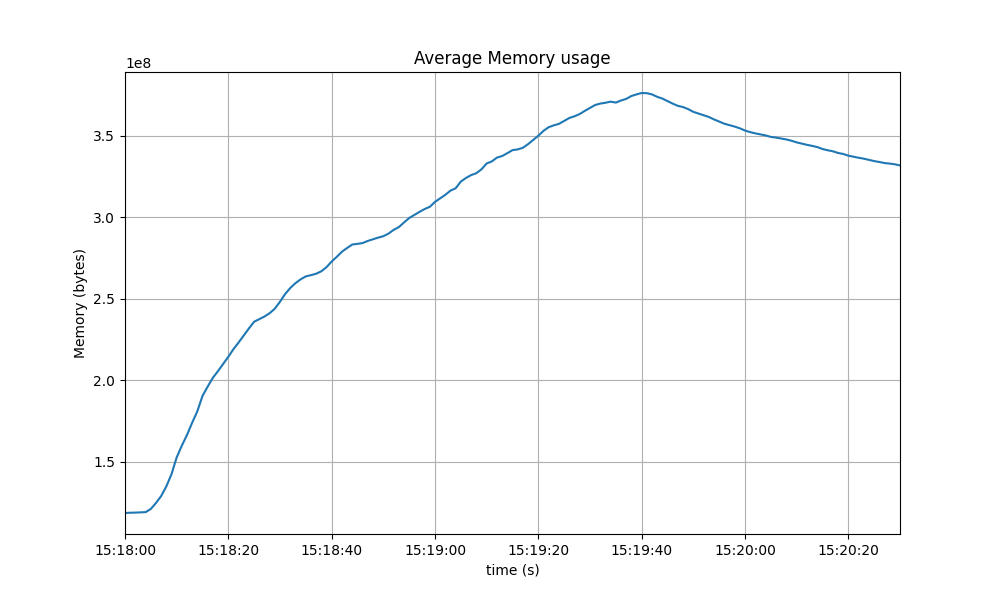
1/3 Tendermint Core - 2/3 CometBFT
2/3 Tendermint Core - 1/3 CometBFT
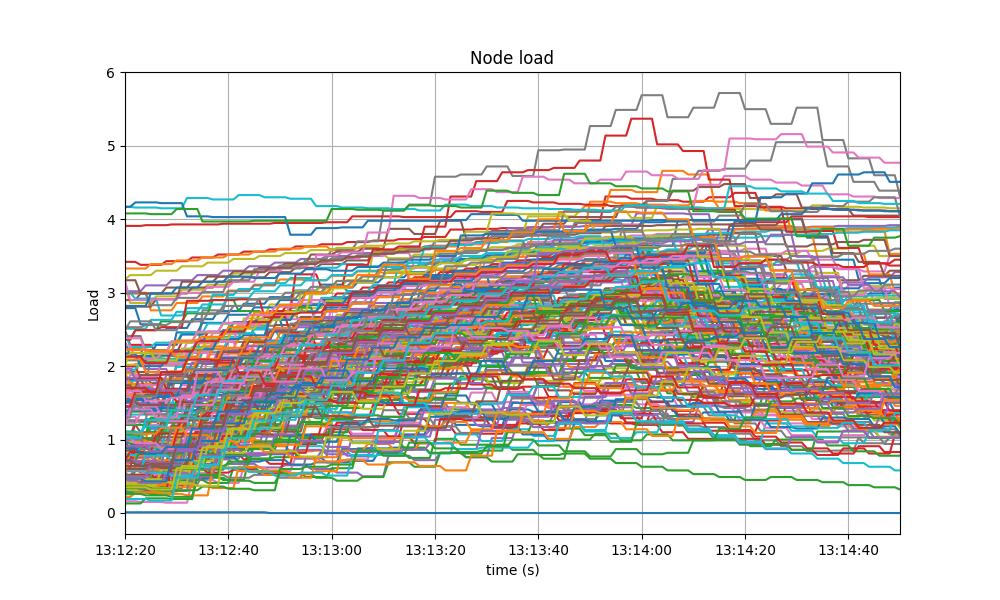
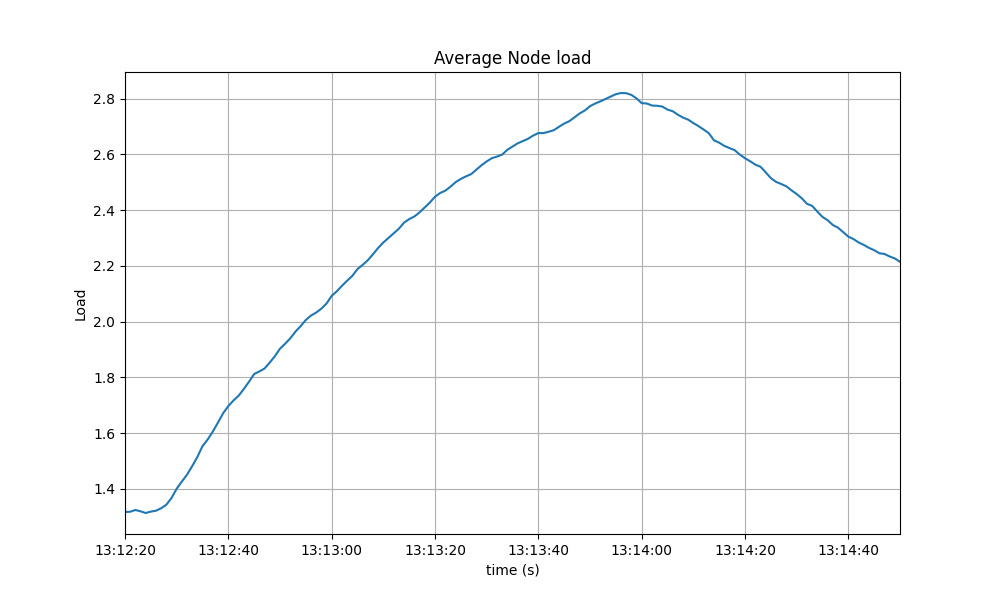
CPU Utilization
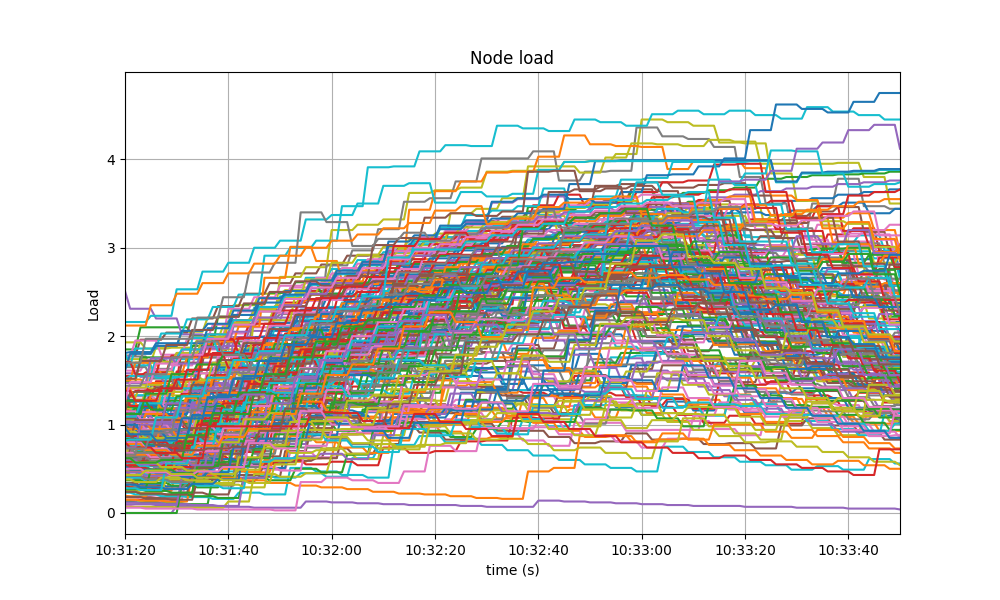
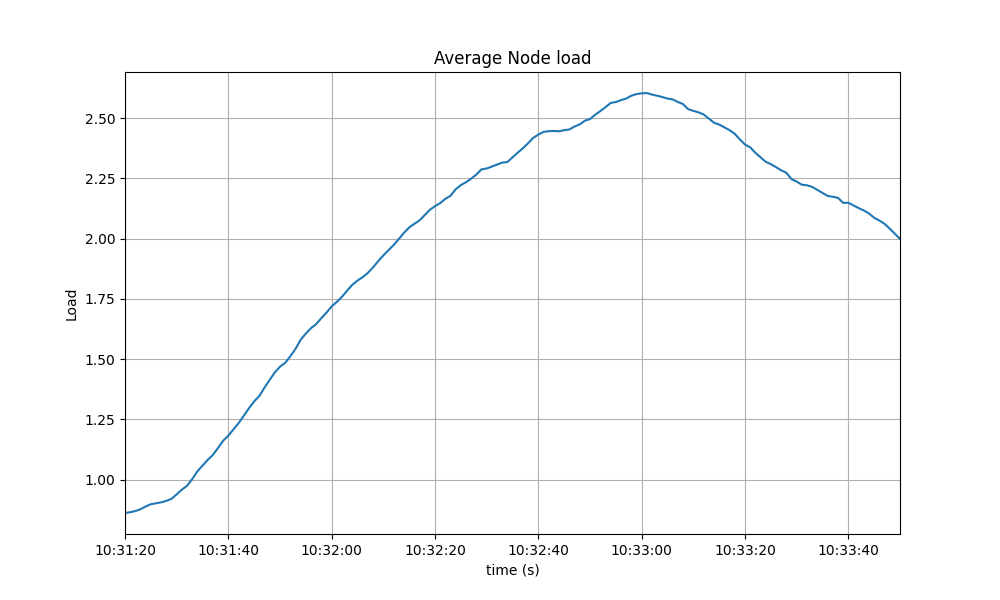
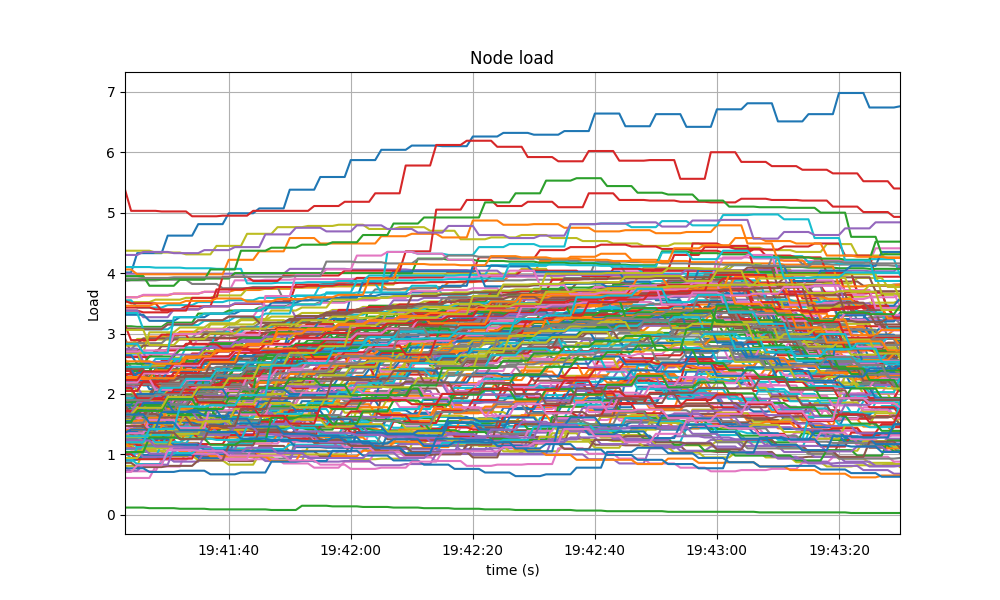
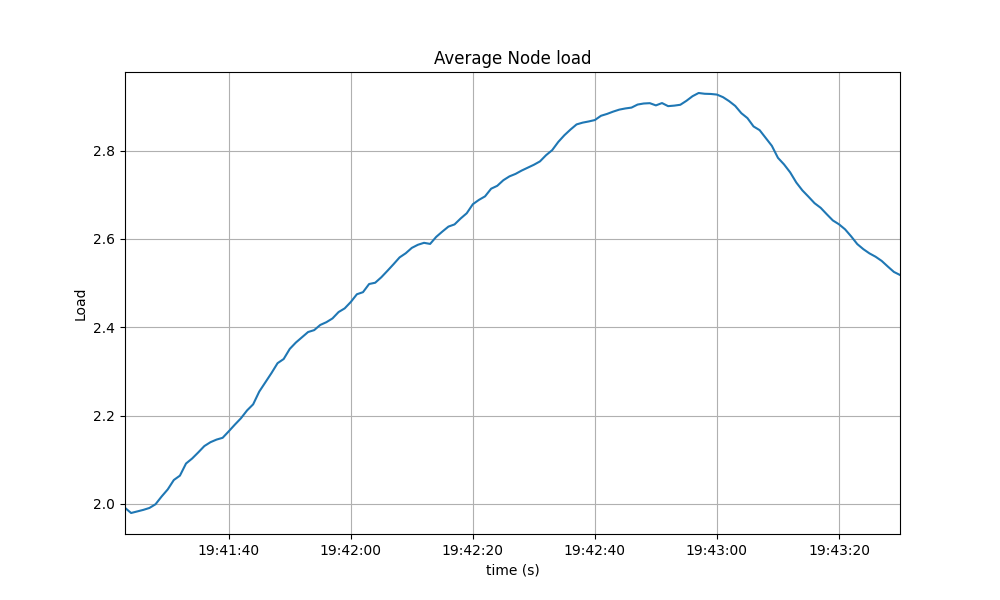
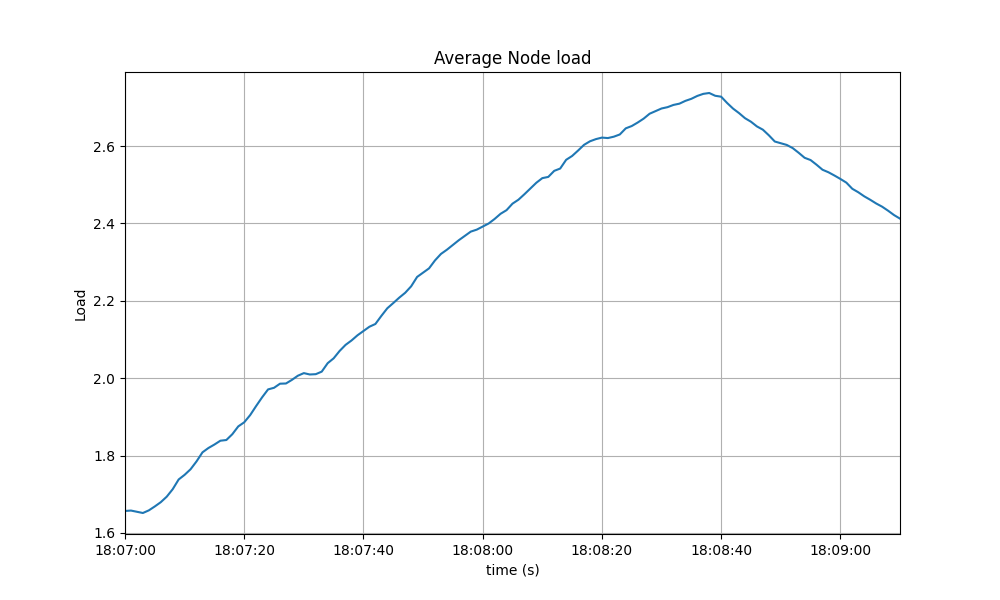
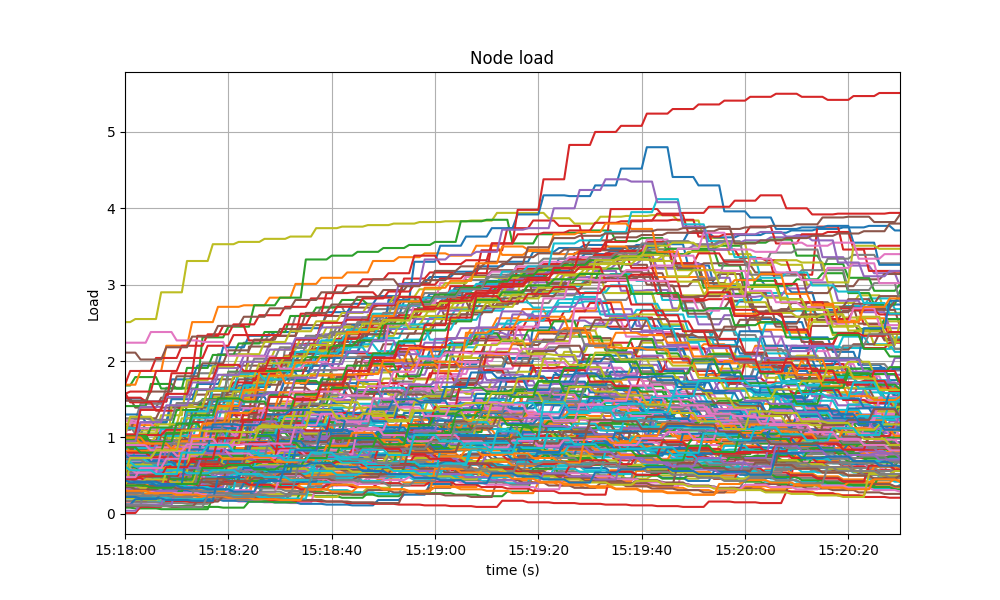
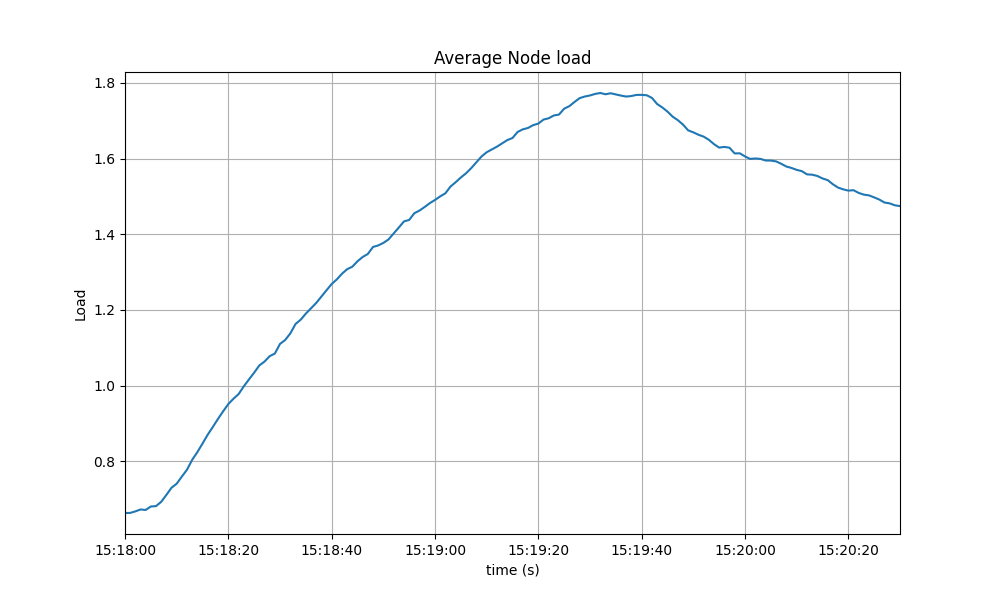
The following graphs show theload1 of nodes, as typically shown in the first line of the Unix top
command, and their average value.
Baseline
CometBFT Homogeneous Network
The load in the homogeneous network is, similarly to the baseline case, below 5 and, therefore, normal.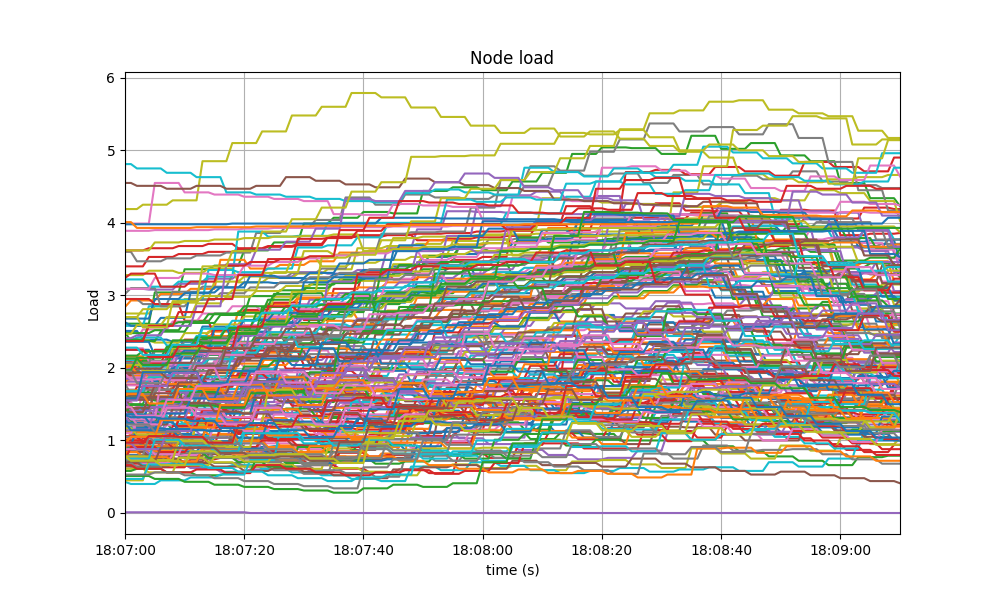
1/2 Tendermint Core - 1/2 CometBFT
1/3 Tendermint Core - 2/3 CometBFT
2/3 Tendermint Core - 1/3 CometBFT