

The Cosmos Network Manager is a unified platform for deploying and operating production-grade Cosmos-based blockchain networks. It provides the infrastructure and tooling required to provision, orchestrate, scale, and secure a distributed ledger in environments with strict reliability, security, and auditability requirements. Operating a distributed ledger is fundamentally different from operating traditional infrastructure.Documentation Index
Fetch the complete documentation index at: https://docs.cosmos.network/llms.txt
Use this file to discover all available pages before exploring further.
- Genesis creation requires isolated transaction generation, aggregation, and redistribution so every node starts with an identical state.
- Network upgrades require all validators to halt at the same block height, upgrade binaries, and restart in a coordinated sequence—capabilities that blockchain protocols do not natively provide.
- Validators must remain isolated from external traffic while preserving low-latency peer communication.
- In regulated environments, all changes must flow through controlled, auditable workflows.
- Infrastructure-as-Code (IaC) tooling, which provisions foundational infrastructure and ledger-specific resources
- Fleet Manager, which programmatically orchestrates node lifecycle operations across the network
| Challenge | How The Cosmos Network Manager Addresses It |
|---|---|
| Coordination overhead | Fleet Manager automates genesis creation, coordinated upgrades, and lifecycle operations via API |
| Network performance | Configurable topology with validator isolation, sentry nodes, and optimized peer settings |
| Scaling | Decoupled IaC and orchestration layers enable independent horizontal and vertical scaling |
| Security | Air-gapped deployment, CI/CD-enforced changes, strict network policies, encrypted storage |
What The Cosmos Network Manager Provides
Deterministic Network Operations
The Cosmos Network Manager replaces manual, error-prone node operations with repeatable, programmatic workflows. High-level API endpoints coordinate low-level actions across all nodes and return a single, authoritative result, enabling safe network initialization, upgrades, recovery procedures, and deterministic redeployment when required.Infrastructure Automation
CLI-based IaC tooling provisions and configures:- Kubernetes-based compute
- Persistent storage and relational databases
- Networking primitives and load balancers
- Ledger node infrastructure and auxiliary services
- IBC relaying and attestation services, including light client configuration, key management, and monitoring
Secure, Auditable Control Plane
All network and infrastructure changes are designed to flow through CI/CD-enforced workflows, ensuring authenticated execution, full auditability, and alignment with enterprise security requirements. The platform supports air-gapped deployment, strict network policies, and encrypted storage by default.Architecture Overview
The Cosmos Network Manager is composed of two core layers that remain decoupled but interoperable: the Infrastructure-as-Code (IaC) tooling and the Fleet Manager.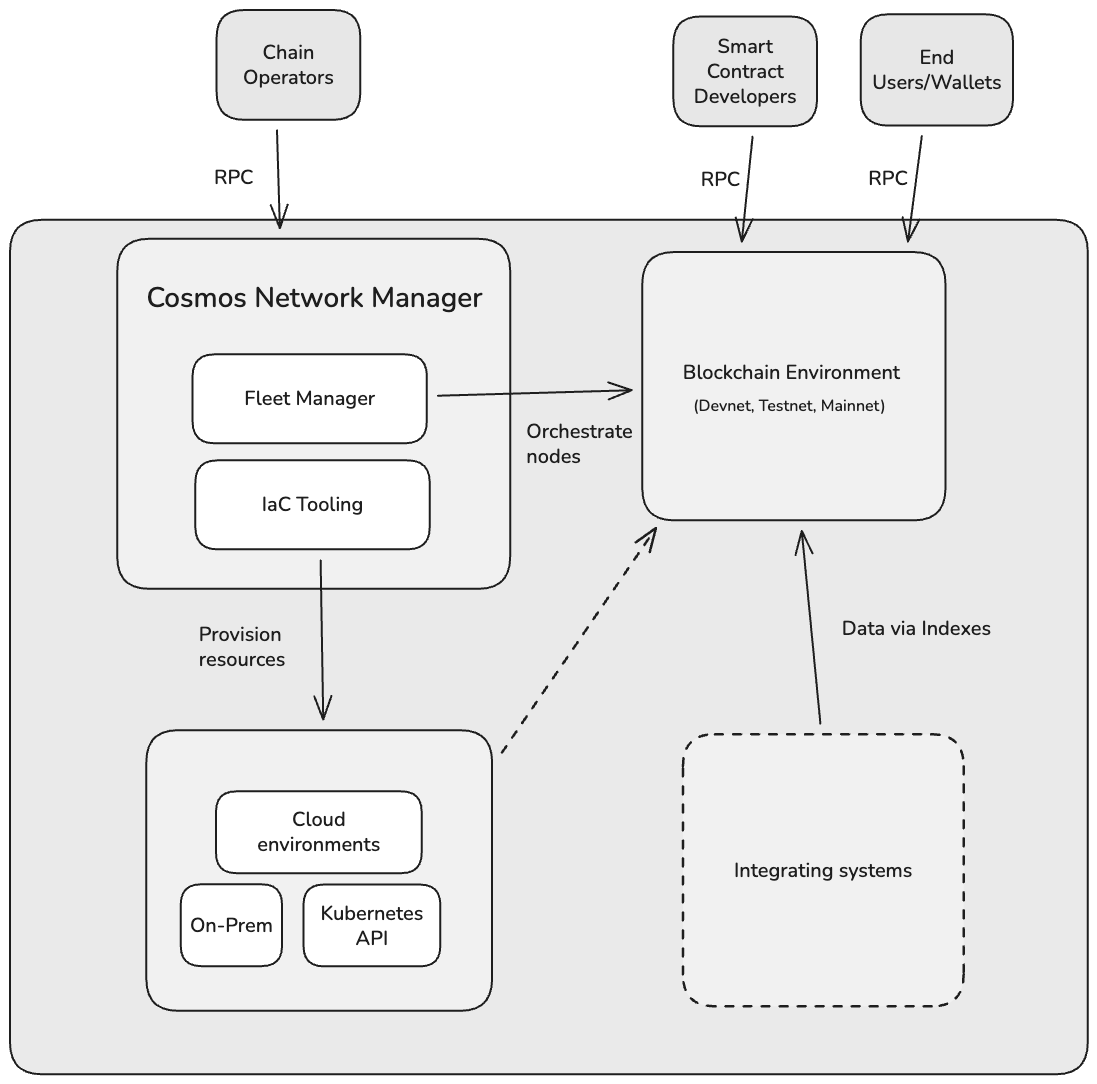
Infrastructure-as-Code Tooling
The IaC tooling provisions a Kubernetes environment alongside relational database services (RDS), blob storage, and network primitives. An observability stack, managed via ArgoCD, is deployed into the same environment. The tooling encapsulates all dependencies required to provision a ledger instance with minimal configuration, enabling teams to focus on application and protocol development rather than infrastructure management. It also allows individual engineers to spin up development and testing environments that mirror production topology. In addition to core ledger infrastructure, the IaC tooling provisions IBC relaying and attestation services required for interchain connectivity. This includes deployment and configuration of relayer processes, light client and IBC smart contract setup, optional remote signing via managed key services, and integration with the observability stack. Access to relaying infrastructure is governed through role-based access control and Kubernetes network policies.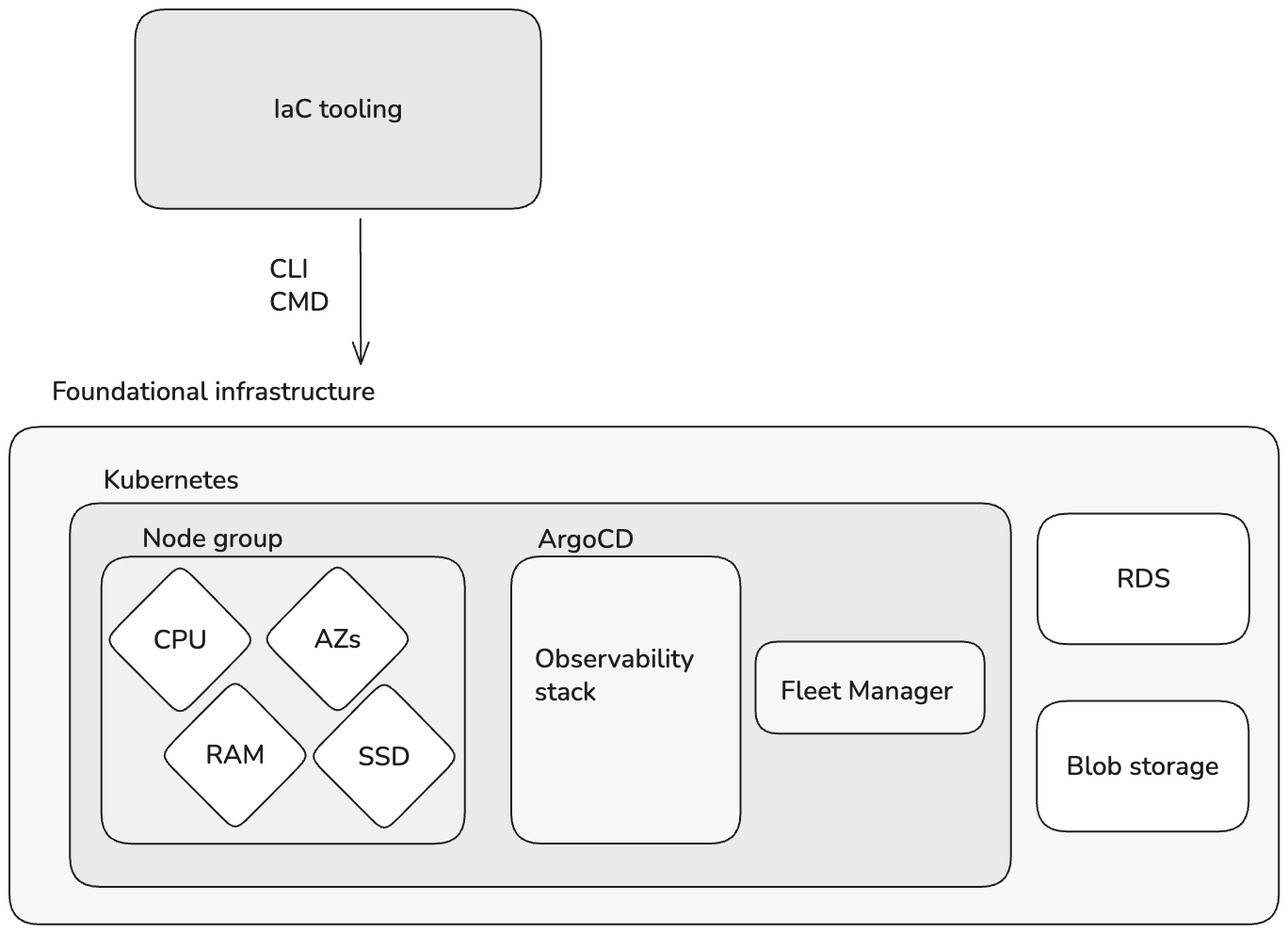
Fleet Manager
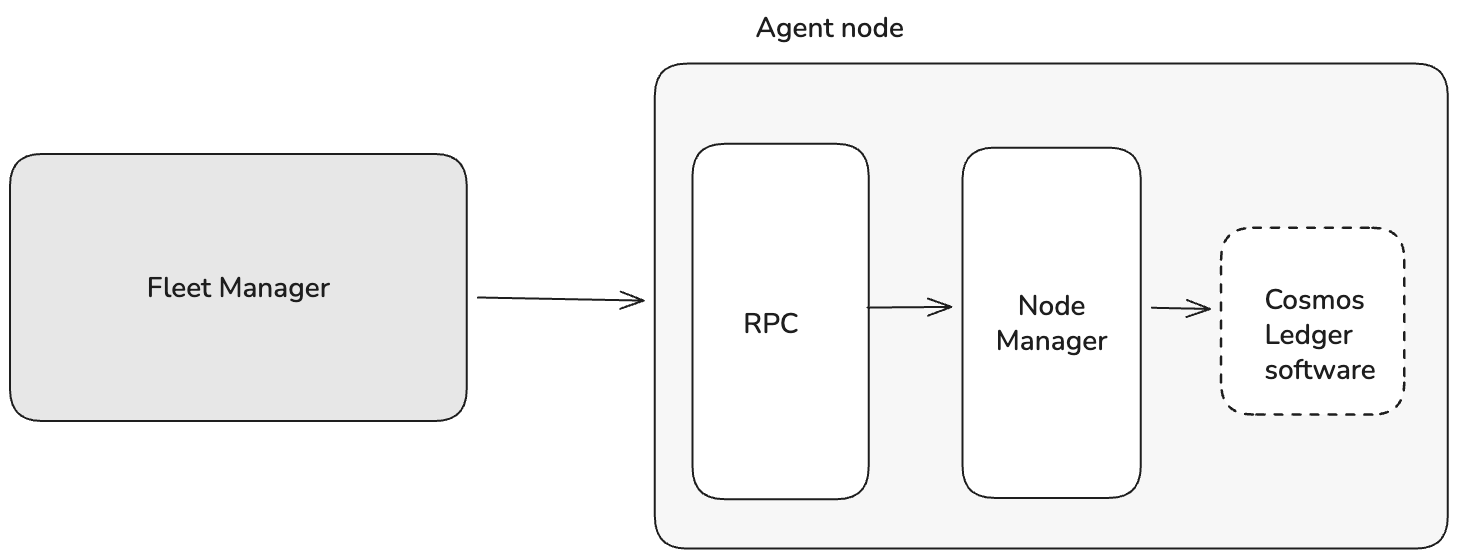
The Fleet Manager is responsible for starting, operating, upgrading, and scaling the ledger. It addresses the coordination challenges inherent to distributed ledger infrastructure through a controller–agent architecture that enables programmatic control over all nodes. The Fleet Manager can be deployed as a Kubernetes service or as a standalone component, depending on operational requirements.Controller–Agent Architecture
- The Fleet Manager acts as the controller
- Ledger nodes run lightweight agent software and must be explicitly registered
- Node Manager, which controls the underlying Cosmos binary and tracks node state
- RPC Server, which receives validated instructions from the Fleet Manager
Network Lifecycle Operations
The Cosmos Network Manager provides composable but decoupled methods for infrastructure provisioning and node orchestration.Network Initialization
- Registers provisioned hardware with the Fleet Manager
- Aggregates validator inputs to generate a single canonical genesis
- Distributes genesis and configuration artifacts
- Starts all nodes deterministically with identical initial state
Coordinated Upgrades
- Stops all nodes at a predefined block height
- Distributes new binaries and configuration
- Restarts nodes in a controlled sequence with safe rollback behavior
Development and Debugging
In non-production environments, engineers can:- Provision local or ephemeral ledger deployments
- View node status and stream logs
- Export genesis and state for debugging and testing
Performance and Scalability
Performance and scalability are achieved through a design that is topology-aware, security-preserving, and operationally consistent.Topology-Aware Consensus
Validators communicate directly over the CometBFT peer-to-peer network. The Fleet Manager initializes validators with a full validator address set marked as private peers, reducing peer-exchange overhead and preserving low-latency block propagation. Validators are isolated behind sentry node architectures, which relay blocks to RPC nodes without exposing validator endpoints.Horizontal Scaling
Query capacity scales independently from consensus by provisioning additional RPC nodes via IaC tooling and registering them with the Fleet Manager. This enables throughput increases without validator disruption.Vertical Scaling
CPU, memory, and storage resources are tunable via Kubernetes node groups. When scaling nodes under Fleet Manager control, agents automatically restart nodes with updated configurations through CI/CD-driven workflows.Security and Enterprise Guarantees
Cosmos Network Manager is included as part of Cosmos Enterprise and benefits from enterprise-grade security and lifecycle commitments:- Air-gapped and restricted-network deployment support
- Encrypted storage and managed secrets
- Fine-grained access control using IAM, RBAC, and network policies
- Long-term support branches and upgrade guidance
- Incident response coordination and defined SLAs
Who The Cosmos Network Manager Is For
The Cosmos Network Manager is designed for:- Production Cosmos-based L1 networks
- Enterprise and institutional operators
- Teams with strict security, compliance, or audit requirements
- Organizations integrating blockchain infrastructure into existing CI/CD and governance frameworks