

Learn how to configure your application to use IBC and send data packets to other chains. This document serves as a guide for developers who want to write their own Inter-blockchain Communication Protocol (IBC) applications for custom use cases. Due to the modular design of the IBC protocol, IBC application developers do not need to concern themselves with the low-level details of clients, connections, and proof verification, however a brief explaination is given. Then the document goes into detail on the abstraction layer most relevant for application developers (channels and ports), and describes how to define your own custom packets, andDocumentation Index
Fetch the complete documentation index at: https://docs.cosmos.network/llms.txt
Use this file to discover all available pages before exploring further.
IBCModule callbacks.
To have your module interact over IBC you must: bind to a port(s), define your own packet data and acknowledgement structs as well as how to encode/decode them, and implement the
IBCModule interface. Below is a more detailed explanation of how to write an IBC application
module correctly.
Pre-requisites Readings
Create a custom IBC application module
Implement IBCModule Interface and callbacks
The Cosmos SDK expects all IBC modules to implement the IBCModule
interface. This
interface contains all of the callbacks IBC expects modules to implement. This section will describe
the callbacks that are called during channel handshake execution.
Here are the channel handshake callbacks that modules are expected to implement:
ChanCloseInit and the finalizing chain calls ChanCloseConfirm.
Channel Handshake Version Negotiation
Application modules are expected to verify versioning used during the channel handshake procedure.ChanOpenInitcallback should verify that theMsgChanOpenInit.Versionis validChanOpenTrycallback should construct the application version used for both channel ends. If no application version can be constructed, it must return an error.ChanOpenAckcallback should verify that theMsgChanOpenAck.CounterpartyVersionis valid and supported.
OnChanOpenTry. The negotiated version
must be returned to core IBC. If the version cannot be negotiated, an error should be returned.
Versions must be strings but can implement any versioning structure. If your application plans to
have linear releases then semantic versioning is recommended. If your application plans to release
various features in between major releases then it is advised to use the same versioning scheme
as IBC. This versioning scheme specifies a version identifier and compatible feature set with
that identifier. Valid version selection includes selecting a compatible version identifier with
a subset of features supported by your application for that version. The struct is used for this
scheme can be found in 03-connection/types.
Since the version type is a string, applications have the ability to do simple version verification
via string matching or they can use the already implemented versioning system and pass the proto
encoded version into each handhshake call as necessary.
ICS20 currently implements basic string matching with a single supported version.
ICS4Wrapper
The IBC application interacts with core IBC through theICS4Wrapper interface for any application-initiated actions like: SendPacket and WriteAcknowledgement. This may be directly the IBCChannelKeeper or a middleware that sits between the application and the IBC ChannelKeeper.
If the application is being wired with a custom middleware, the application must have its ICS4Wrapper set to the middleware directly above it on the stack through the following call:
Custom Packets
Modules connected by a channel must agree on what application data they are sending over the channel, as well as how they will encode/decode it. This process is not specified by IBC as it is up to each application module to determine how to implement this agreement. However, for most applications this will happen as a version negotiation during the channel handshake. While more complex version negotiation is possible to implement inside the channel opening handshake, a very simple version negotiation is implemented in the ibc-transfer module. Thus, a module must define its custom packet data structure, along with a well-defined way to encode and decode it to and from[]byte.
PacketData into a structure it expects so that it can
act on it.
Packet Flow Handling
Just as IBC expected modules to implement callbacks for channel handshakes, IBC also expects modules to implement callbacks for handling the packet flow through a channel. Once a module A and module B are connected to each other, relayers can start relaying packets and acknowledgements back and forth on the channel.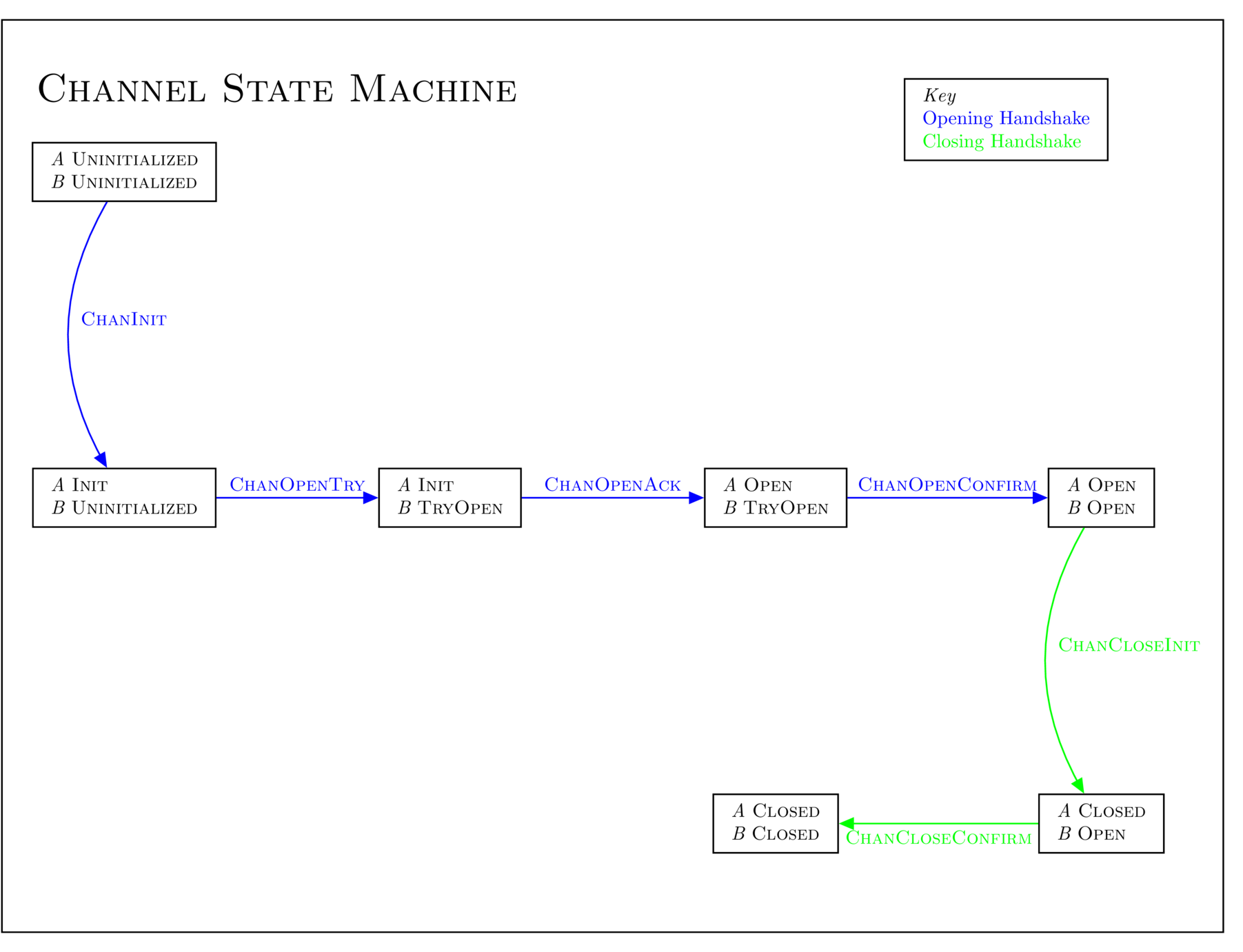 Briefly, a successful packet flow works as follows:
- module A sends a packet through the IBC module
- the packet is received by module B
- if module B writes an acknowledgement of the packet then module A will process the acknowledgement
- if the packet is not successfully received before the timeout, then module A processes the packet’s timeout.
Sending Packets
Modules do not send packets through callbacks, since the modules initiate the action of sending packets to the IBC module, as opposed to other parts of the packet flow where msgs sent to the IBC module must trigger execution on the port-bound module through the use of callbacks. Thus, to send a packet a module simply needs to callSendPacket on the IBCChannelKeeper.
Receiving Packets
To handle receiving packets, the module must implement theOnRecvPacket callback. This gets
invoked by the IBC module after the packet has been proved valid and correctly processed by the IBC
keepers. Thus, the OnRecvPacket callback only needs to worry about making the appropriate state
changes given the packet data without worrying about whether the packet is valid or not.
Modules may return to the IBC handler an acknowledgement which implements the Acknowledgement interface.
The IBC handler will then commit this acknowledgement of the packet so that a relayer may relay the
acknowledgement back to the sender module.
The state changes that occurred during this callback will only be written if:
- the acknowledgement was successful as indicated by the
Success()function of the acknowledgement - if the acknowledgement returned is nil indicating that an asynchronous process is occurring
OnRecvPacket callback will be written
for asynchronous acknowledgements.
Acknowledgements
Modules may commit an acknowledgement upon receiving and processing a packet in the case of synchronous packet processing. In the case where a packet is processed at some later point after the packet has been received (asynchronous execution), the acknowledgement will be written once the packet has been processed by the application which may be well after the packet receipt. NOTE: Most blockchain modules will want to use the synchronous execution model in which the module processes and writes the acknowledgement for a packet as soon as it has been received from the IBC module. This acknowledgement can then be relayed back to the original sender chain, which can take action depending on the contents of the acknowledgement. Just as packet data was opaque to IBC, acknowledgements are similarly opaque. Modules must pass and receive acknowledegments with the IBC modules as byte strings. Thus, modules must agree on how to encode/decode acknowledgements. The process of creating an acknowledgement struct along with encoding and decoding it, is very similar to the packet data example above. ICS 04 specifies a recommended format for acknowledgements. This acknowledgement type can be imported from channel types. While modules may choose arbitrary acknowledgement structs, a default acknowledgement types is provided by IBC here:Acknowledging Packets
After a module writes an acknowledgement, a relayer can relay back the acknowledgement to the sender module. The sender module can then process the acknowledgement using theOnAcknowledgementPacket callback. The contents of the
acknowledgement is entirely up to the modules on the channel (just like the packet data); however, it
may often contain information on whether the packet was successfully processed along
with some additional data that could be useful for remediation if the packet processing failed.
Since the modules are responsible for agreeing on an encoding/decoding standard for packet data and
acknowledgements, IBC will pass in the acknowledgements as []byte to this callback. The callback
is responsible for decoding the acknowledgement and processing it.
Timeout Packets
If the timeout for a packet is reached before the packet is successfully received or the counterparty channel end is closed before the packet is successfully received, then the receiving chain can no longer process it. Thus, the sending chain must process the timeout usingOnTimeoutPacket to handle this situation. Again the IBC module will verify that the timeout is
indeed valid, so our module only needs to implement the state machine logic for what to do once a
timeout is reached and the packet can no longer be received.
Routing
As mentioned above, modules must implement the IBC module interface (which contains both channel handshake callbacks and packet handling callbacks). The concrete implementation of this interface must be registered with the module name as a route on the IBCRouter.
Working Example
For a real working example of an IBC application, you can look through theibc-transfer module
which implements everything discussed above.
Here are the useful parts of the module to look at:
Binding to transfer
port
Sending transfer
packets
Implementing IBC
callbacks