

The Interoperability Solution
Blockchains are isolated by design. Chain A has no access to Chain B’s state, and they cannot call each other the way web services can. Connecting them traditionally meant trusting a third party to relay information honestly, which introduces a single point of failure and requires ongoing trust in an external operator. IBC is the solution to this problem: it replaces trusted operators with cryptographic proofs. Each chain runs a light client that tracks the counterparty chain’s state. When a message arrives on Chain B, Chain B’s light client verifies that it was actually committed on Chain A. IBC is also permissionless. Anyone can submit proofs to either chain, and each chain verifies them independently. IBC is flexible in how that verification works. A consensus light client tracks block headers and validates them against the counterparty’s consensus rules. An attestation light client relies on a committee, oracle network, or existing signing infrastructure instead. Chains choose the verification approach that fits their security model.IBC Layers
IBC is organized into three layers that can be swapped independently: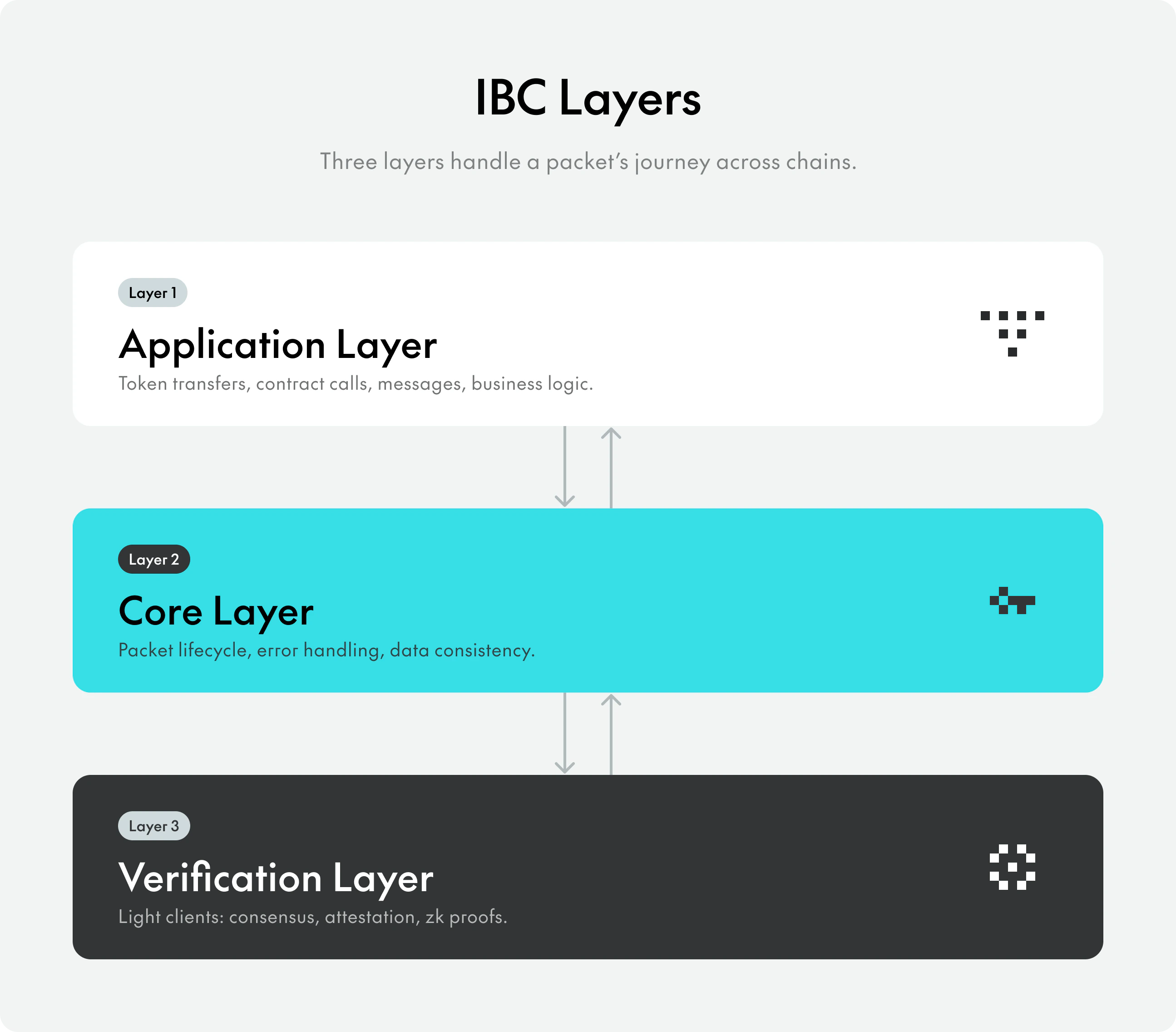
- The application layer is where users and cross-chain actions interact. IBC applications can be anything: token transfers, contract calls, arbitrary messaging, or custom logic built for a specific use case.
- The core layer manages the packet lifecycle: sequencing, replay prevention, timeout enforcement, and proof verification. Applications never deal with this directly.
- The verification layer handles how cross-chain state is proven. This is where light clients live, and different client types can be swapped in without affecting the layers above.