

PoA Module Architecture
Overview
The Proof of Authority (PoA) permissioned consensus module is a Cosmos SDK module that implements a permissioned consensus mechanism where a designated admin controls the validator set. Unlike traditional Proof of Stake systems, PoA validators are explicitly authorized and managed by an administrative authority rather than being selected based on staked tokens.Table of Contents
- Architecture
- Admin Control Flow
- Validator Lifecycle
- Fee Distribution → See the Distribution page
- Governance → See the Governance page
- Technical Implementation
- Security Considerations
Architecture
SDK Integration Points
The PoA module plugs into the Cosmos SDK as a replacement for the standard staking module, providing an alternative consensus mechanism: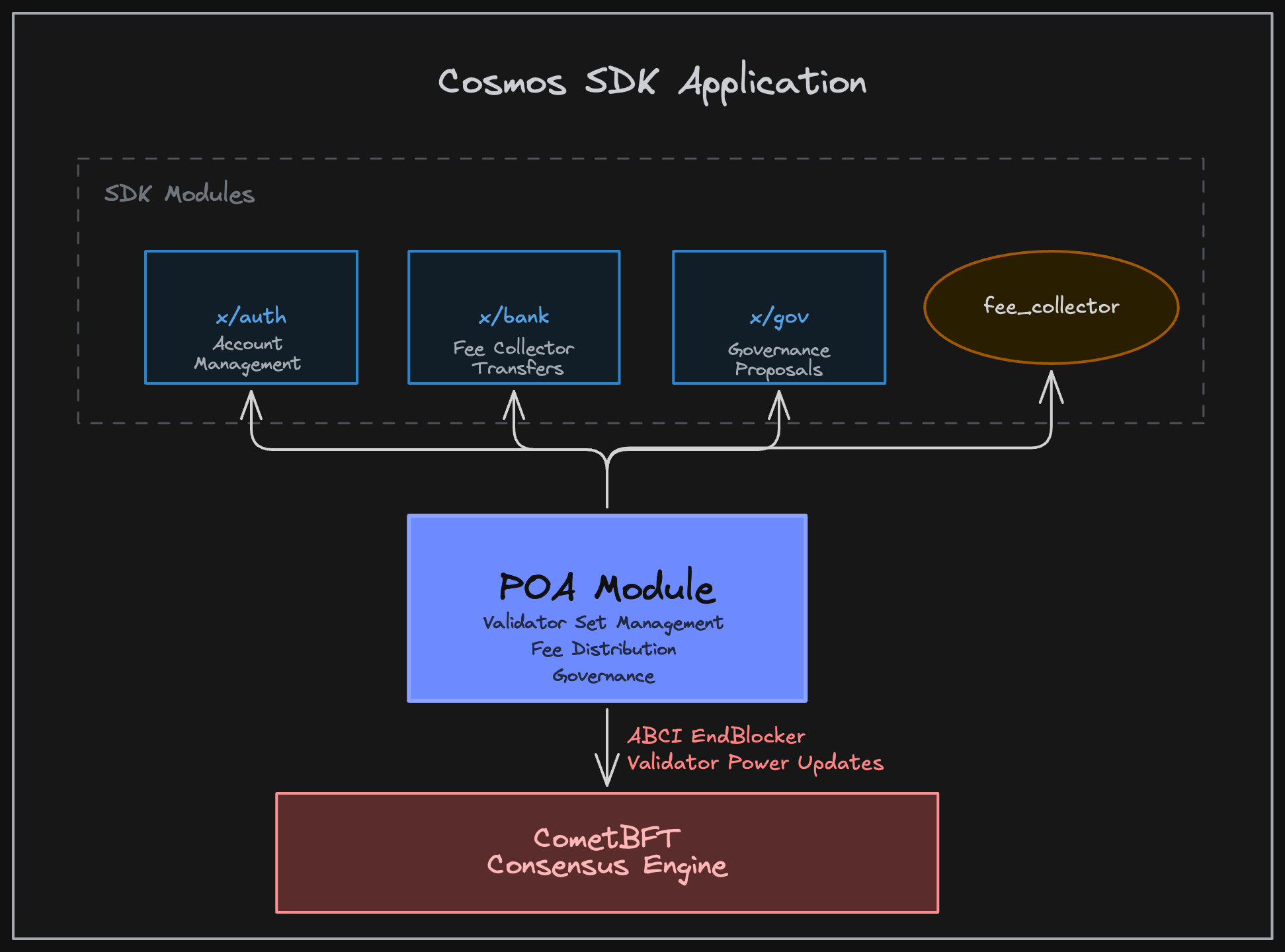
- Replaces x/staking: PoA provides validator management without token delegation or bonding
- Integrates with x/gov: Custom governance hooks ensure only active validators can participate and tally function override allocates vote weight to validator power (details)
- Uses x/auth & x/bank: Standard account and token management for fee distribution (details)
- ABCI Lifecycle: Implements
EndBlockerto communicate validator updates to CometBFT (details)
Architectural Decisions
Admin-Controlled Validator Set Unlike proof-of-stake where validators are determined by token weight, PoA uses a single admin address to authorize validators. This design choice:- Enables permissioned networks with known validator identities
- Removes token requirement from validator participation (no token bonding required)
- Centralizes trust in the admin address (see Security Considerations)
- Fees are routed to the PoA module account via a custom ante handler (see Fee Routing Setup for complete details).
- Fees allocated proportionally to validator power (not delegated stake)
- Validators withdraw fees on-demand
- See Fee Distribution for complete details
- Only active validators (power > 0) can submit, deposit, or vote on proposals
- Voting weight determined by validator power, not token holdings
- Prevents non-validator governance participation
- See Governance for implementation details
cosmossdk.io/collections with an indexed map:
- Primary key: consensus address
- Secondary indexes on operator address and power, for fast lookups and power-sorted iteration
- See Storage Design for technical details
Admin Control Flow
Setting Admin Authority
The PoA module is controlled by a single admin address configured at genesis. This admin has exclusive authority to:- Update validator power (grant/revoke consensus participation)
- Modify module parameters
- Batch update the entire validator set
x/poa/types/keys.go:26 (params prefix)
Only the admin can update itself with a parameter change.
Managing Validator Set
MsgUpdateValidators (x/poa/keeper/msg_server.go:142)
The admin can batch update validators through a single transaction:
- Authentication: Transaction must be signed by the admin address
- Validation: Each validator update is validated for:
- Valid public key
- Non-negative power
- Valid metadata (operator address, moniker, description)
- No duplicate operator addresses
- Power Changes: Any power change triggers:
- Fee checkpoint (allocates pending fees before power changes)
- Total power recalculation
- ABCI validator update queue
- Consensus Update: Changes take effect in the next block
Updating Parameters
MsgUpdateParams (x/poa/keeper/msg_server.go:45)
The admin can update module parameters (currently only the admin address itself). This requires:
- Transaction signed by current admin
- Validation of new parameters
Validator Lifecycle
Validator Registration
MsgCreateValidator (x/poa/keeper/msg_server.go:79)
Admin-Only Creation: Only the admin can register a validator:
-
Submit Registration: Provide public key and metadata
- PubKey: Ed25519
- Operator Address: Account that will receive fees and manage the validator
- Moniker: Human-readable name (max 256 chars)
- Description: Additional details (max 256 chars)
-
Initial State: The admin sets the validator’s initial power. A validator with power = 0 is inactive:
- Not participating in consensus
- Not earning fees
- Cannot vote in governance
x/poa/keeper/validator.go:121
Gaining Consensus Power
Validators can only gain consensus power through admin action:- Admin Updates Power: Via
MsgUpdateValidators - Power > 0: Validator becomes active
- ABCI Update: CometBFT adds validator to active set at next block
- Fee Eligibility: Validator starts accumulating fees proportionally
- Governance Rights: Validator can submit proposals, deposit, and vote
- Power is an integer representing voting weight
- Higher power = more consensus influence and fee share
- Power can be adjusted up or down by admin
- Setting power = 0 removes validator from consensus without deleting
x/poa/keeper/validator.go:34
Removing Validators
Soft Removal (Removing power):- Admin sets validator power to 0
- Validator remains registered but inactive
- Can be reactivated by admin later
- Validator entry is preserved in the map of validators
Fee Distribution
The PoA module implements a custom checkpoint-based fee distribution system that allocates block fees proportionally to validator power. Key Features:- Fees accumulate in the PoA module account
- Allocated proportionally to validator power at checkpoints
- Checkpoints triggered by power changes or withdrawals
- Validators withdraw accumulated fees on-demand
- Uses DecCoins for precision to prevent dust accumulation
x/poa/keeper/distribution.go
Governance
The PoA module restricts governance participation to active validators only, using validator power as voting weight instead of bonded tokens. Key Features:- Uses existing x/gov module
- Only active validators (power > 0) can submit, deposit, or vote on proposals
- Voting weight equals validator power
- Custom tally function replaces standard governance tallying
- Admin indirectly controls governance through power distribution
x/poa/keeper/governance.go and x/poa/keeper/hooks.go
Technical Implementation
Storage Design
Collections Schema (x/poa/types/keys.go)
The module uses cosmossdk.io/collections for type-safe state management:
Location:
x/poa/keeper/keeper.go:38
ABCI Integration
EndBlocker (x/poa/keeper/abci.go:30)
The module integrates with CometBFT consensus through ABCI:
- Power Changes: When validator power changes, create
ValidatorUpdate - Queue Updates: Store updates in memory queue
- EndBlock: At end of block, return all queued updates
- CometBFT Processing: Consensus engine applies updates for next block
- Clear Queue: After returning, clear the queue
x/poa/module.go:266
Security Considerations
-
Single Point of Control:
- Admin address controls entire validator set
-
Validator Registration:
- Only the admin can register a validator
- Only the admin can grant consensus power
-
Total Power Invariant:
- Total power must remain > 0
- Prevents zero-power chain halts
- Validated on every power adjustment via a checkpoint trigger
-
Governance Restrictions:
- Only active validators (power > 0) can participate
- Prevents governance spam from unauthorized users
- Ensures governance represents actual consensus participants
-
Validator Indexing:
- Unique consensus address prevents duplicate validators
- Unique operator address prevents fee confusion